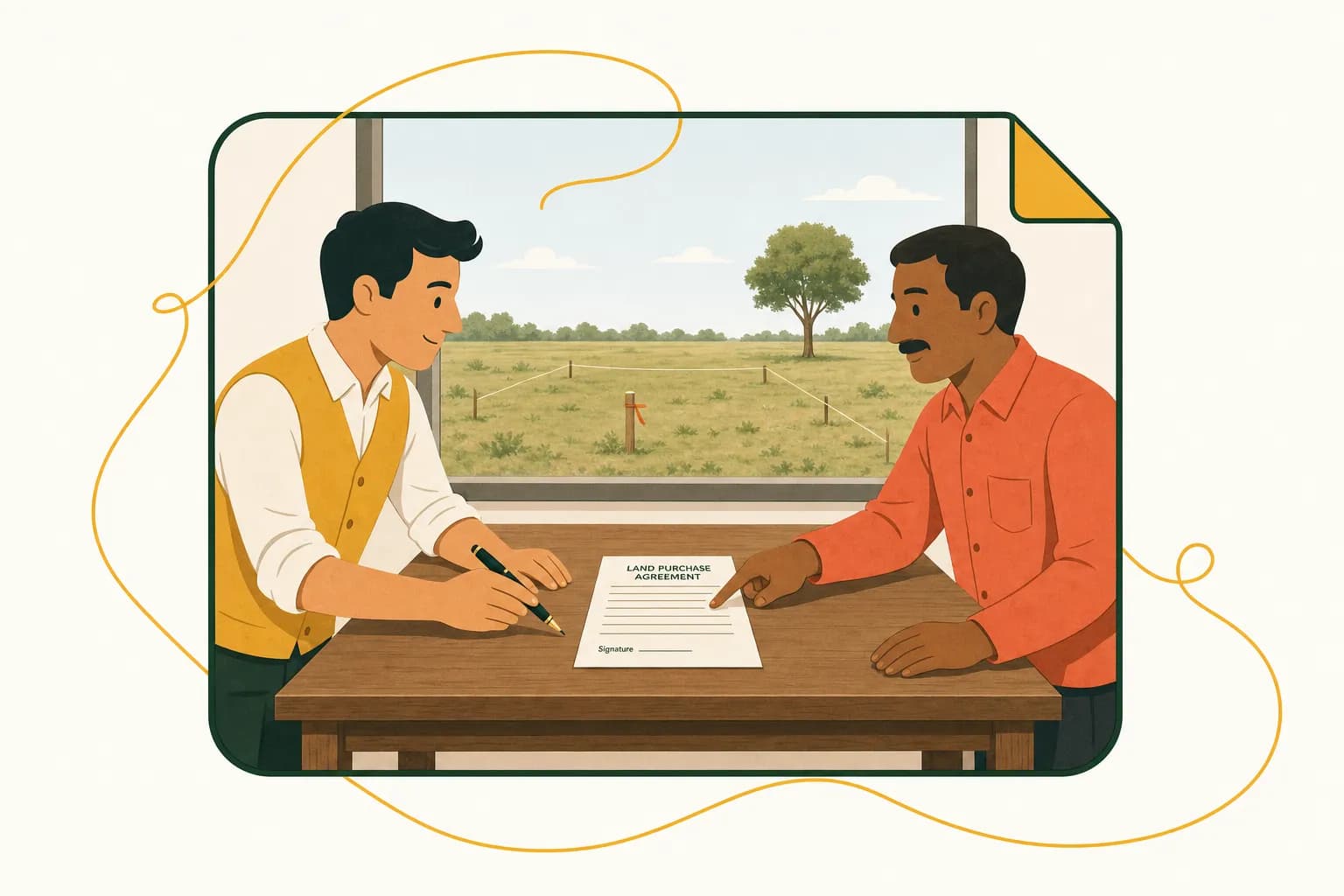
What Is a Simple Land Purchase Agreement?
A simple land purchase agreement is a written contract that spells out the terms under which one party sells a piece of vacant or undeveloped land to another. It names the buyer and seller, describes the property being sold, sets the price, and lays out the conditions both sides need to meet before the sale closes. Think of it as the rulebook for the transaction — without it, you're basically trading land on a handshake, and I don't need to tell you how risky that can get when real money and real property are on the line.
Here's the thing: land deals are often simpler than home sales, but "simpler" doesn't mean "no paperwork needed." When you're buying an empty lot — maybe to build on later, maybe just as an investment — there's no house, no inspection report on a leaky roof, no mortgage tied to a structure. That's exactly why a leaner, more direct agreement makes sense. You still need to nail down the legal description of the property, the purchase price, how and when payment happens, and what condition the land needs to be in at closing (are there liens? easements? access rights?).
The purpose of this document is straightforward: it legally transfers ownership from seller to buyer once both parties have satisfied their obligations. It protects the buyer by confirming they're getting clear title to the property they think they're getting. It protects the seller by locking in the buyer's commitment to pay. And it gives both sides a paper trail if a dispute ever comes up down the road — which, let's be honest, is the kind of thing you hope you never need but will be very glad to have if you do.
A land purchase agreement isn't just a formality — it's a binding contract, which means it has to meet the same basic legal standards as any other contract. That includes offer, acceptance, consideration, and mutual consent. If you want a deeper breakdown of what makes an agreement enforceable, our post on the elements of a valid contract covers this in plain language.
Because land deals fall under real estate law, many states require these agreements to be in writing to be enforceable — a rule rooted in what's known as the Statute of Frauds. That's part of why templates exist: they help make sure you're not missing a required clause simply because you didn't know it needed to be there.
One more thing worth knowing upfront — signing requirements for land agreements can vary by state and situation. Some transactions call for a witness, and increasingly, digital signatures are accepted for real estate contracts, though the rules aren't identical everywhere. If you're curious how that applies to land and property deals specifically, check out our guide on electronic signatures for real estate.
Free Simple Land Purchase Agreement Template
Download this free template and customize it for your needs.
Key Elements Every Land Purchase Agreement Should Include
Every solid land purchase agreement rests on four pillars: who's involved, what's being sold, how much it costs, and how payment happens. Skip any one of these, and you're basically building a house on sand. Let's break down what actually needs to be in there.
Buyer and Seller Information
This sounds obvious, but I've seen agreements that get sloppy here. You need full legal names, current mailing addresses, and — if either party is a business entity rather than an individual — the entity's official registered name and state of formation. If you're buying land through an LLC, don't just write "John's Company." Use the exact name filed with your Secretary of State's office. Sloppy identification here can create headaches later if there's ever a title dispute or you need to enforce the contract.
Property Description
A simple street address isn't enough for raw land, and sometimes there isn't even an address yet. You need the legal description — the one pulled from the deed, plat map, or county tax records. This typically includes lot and block numbers, metes and bounds descriptions, or a reference to a recorded plat. The American Land Title Association notes that inaccurate legal descriptions are one of the most common sources of title problems down the road. If you're unsure how to pull the correct description, your county recorder's office or a title company can help you get it right the first time.
Purchase Price
State the total price clearly, and don't leave room for ambiguity. Is the price for the entire parcel, or per acre? Are there any contingencies that could adjust the price — like a survey revealing fewer usable acres than expected? Spell it out. Vague pricing language is where deals fall apart or end up in disputes.
Payment Terms
This is where a lot of simple templates get too simple. You need to specify:
- The amount of any earnest money deposit and where it's held (usually in escrow)
- Whether the buyer is paying cash, financing through a lender, or if the seller is offering seller financing
- The closing timeline and what happens if it's delayed
- How remaining funds get transferred at closing — wire transfer, cashier's check, etc.
If seller financing is involved, you'll want additional terms covering interest rate, repayment schedule, and default remedies. The Consumer Financial Protection Bureau offers useful background on financing disclosures, even though land deals aren't always subject to the same rules as residential mortgages.
Get these four elements right, and you've got a contract that actually protects both sides — not just one that looks official. If you want a head start instead of building from scratch, you can try Dochives free at https://dochives.com and see how much faster it is to draft, send, and sign land purchase agreements without missing the details that matter.
Common Contingencies in Land Purchase Agreements
Think of contingencies as your escape hatches. They're the "only if" clauses that let you (or the seller) back out of a deal without losing your deposit if certain conditions aren't met. I've seen buyers skip these to make their offer look "cleaner" — and I've also seen those same buyers get stuck with a swamp they can't build on. Don't be that person.
Financing contingency. If you're not paying cash, you need this clause. It gives you a window — typically 30 to 45 days — to secure a loan before you're legally on the hook to close. Land loans are notoriously trickier to get than home mortgages; many lenders view raw land as riskier collateral, so approval can take longer or fall through entirely. Without a financing contingency, a denied loan application could still leave you liable for the purchase or your earnest money. The Consumer Financial Protection Bureau has useful background on how financing timelines and approvals typically work if you want to dig deeper.
Inspection contingency. Land might look simple — it's just dirt, right? Not quite. Soil composition, drainage, flood risk, and even hidden debris can turn a "buildable lot" into a money pit. An inspection contingency gives you time to bring in a surveyor, environmental assessor, or perc tester (especially important if you're planning a septic system) and walk away if the findings are bad. The EPA's brownfields program is a good reference if you're buying land with any history of industrial or commercial use.
Title search contingency. This one protects you from inheriting someone else's mess — unpaid liens, boundary disputes, or unclear ownership history. A title company or real estate attorney runs a search to confirm the seller actually has the legal right to sell, and that no one else has a claim buried in the property's past. If problems surface, this contingency lets you renegotiate or exit cleanly instead of closing on a legal headache.
Zoning contingency. Here's a big one people overlook: just because you want to build a cabin, a duplex, or a storage facility doesn't mean the local zoning code allows it. A zoning contingency lets you confirm with the county or municipal planning office that your intended use is permitted — or that you can realistically get a variance — before you're locked into the purchase. Zoning rules vary wildly by jurisdiction, so checking with your local planning department (many are listed through resources like the American Planning Association) is worth the extra week it might take.
Each of these contingencies adds a bit of friction to the deal, sure. But that friction is protection. A simple land purchase agreement isn't about rushing to the finish line — it's about making sure both sides know exactly what they're getting into, with clear exits if reality doesn't match expectations.
Earnest Money Deposits and Closing Timelines
Let's talk about money on the line — because that's really what earnest money is. It's the deposit you put down to show a seller you're serious about buying their land, and it's one of the parts of a simple land purchase agreement that trips people up the most. If you've never bought raw land before, the whole process can feel a little different than buying a house, and the timelines especially need some real thought.
So how does earnest money actually work? Once you and the seller agree on a price, you'll typically put down a deposit — usually somewhere between 1% and 10% of the purchase price, though for land deals it's often a flat amount rather than a percentage, especially on smaller parcels. That money doesn't go straight to the seller. It should sit in an escrow account, held by a neutral third party like a title company or real estate attorney, until closing. Think of it as a good-faith handshake with a paper trail. If the deal falls through for a reason covered by your contingencies (say, a bad survey or title problem), you get your deposit back. If you walk away for no valid reason, the seller usually gets to keep it.
I always tell people: read the earnest money clause twice. It should spell out exactly who's holding the funds, under what conditions they're refundable, and what happens if the deal collapses because of a dispute. Vague language here is a recipe for a fight later. The Consumer Financial Protection Bureau has general guidance on how escrow accounts function that's worth a skim if you've never dealt with one before.
Now, closing timelines. This is where land deals often move slower than you'd expect — and that's okay, as long as you plan for it. Unlike a house, raw land frequently needs extra due diligence: perc tests for septic suitability, zoning verification, boundary surveys, maybe even environmental assessments if there's any history of agricultural or industrial use. Rushing a 15-day closing on land you haven't fully vetted is asking for trouble.
A more realistic window is 30 to 60 days, depending on how much investigating needs to happen. If you're financing the purchase, add time — land loans often take longer to underwrite than traditional mortgages since lenders view raw land as higher risk. If you're paying cash and the title's already clean, you might close in a couple of weeks.
Here's a practical tip: build your timeline backward from your contingency deadlines. If your due diligence period is 30 days, don't set closing for day 31 — give yourself a buffer in case a survey gets delayed or a county office is slow to pull permit records. Rural counties, in particular, aren't always fast movers when it comes to paperwork.
Whatever timeline you land on, put it in writing with specific dates, not vague phrases like "within a reasonable time." Specificity protects everyone, including you.
Signatures, Witnesses, and Notarization Requirements
Here's something I see trip up a lot of first-time land buyers and sellers: they treat the signature line like an afterthought. You've negotiated the price, hashed out contingencies, agreed on a closing date — and then you just... sign it, scan it, and call it done. But how you execute a land purchase agreement can matter just as much as what's written in it. A beautifully drafted contract with a sloppy signing process can end up unenforceable, and that's a nightmare nobody wants to discover after money has already changed hands.
Let's start with the basics. Every party to the agreement — every buyer and every seller listed — needs to sign. If a property is jointly owned, say by spouses or business partners, all owners typically need to sign for the transfer to be valid. Miss a signature from a co-owner, and you might find out later that you don't actually have a binding deal on the whole parcel, just a portion of it.
Now here's where it gets state-specific, and why I always tell people not to assume their neighbor's process applies to them. Some states require a witness signature in addition to the parties' signatures, particularly for real estate transactions. Others don't require witnesses at all but do require notarization for certain documents, especially deeds. And a few states have specific statutory language that must appear in land contracts to be enforceable. This isn't uniform across the country, so what worked for your cousin's land deal in Georgia might not fly in Ohio.
Notarization deserves special attention because it does more than add a rubber stamp of formality. A notary public verifies the identity of the signers and confirms they're signing willingly, without coercion. This matters enormously for land transactions since fraud and disputes over authenticity are exactly the kind of thing courts scrutinize when a deal goes sideways. The National Notary Association offers helpful state-by-state guidance if you're unsure what's required where you're transacting.
It's also worth noting that while the purchase agreement itself may not always require notarization, the deed that eventually transfers title almost always does. Recording requirements vary too — most counties require the deed to be recorded with the local recorder of deeds or land records office to be enforceable against future claims. Check your county's recorder of deeds office or state-specific real estate authority for exact rules before you assume you're covered.
Electronic signatures have become widely accepted for many real estate documents, thanks to laws like the federal ESIGN Act and the Uniform Electronic Transactions Act adopted by most states. That said, some jurisdictions still carve out exceptions for real property transfers, so it's smart to verify before you rely entirely on a digital signature for something this significant.
The bottom line? Don't guess on execution requirements. A quick consultation with a local real estate attorney, or even a call to your county clerk's office, can save you from a technicality unraveling an otherwise solid agreement. Getting the paperwork right and getting the signatures right are two very different jobs — and land deals require you to nail both.
Purchase Agreement vs. Deed vs. Title Transfer: What's the Difference?
I get this question a lot, and honestly, it trips up even experienced buyers: aren't these all basically the same thing? Nope. Each document plays a distinct role in a land sale, and mixing them up can cost you time, money, or worse — a deal that falls apart because you signed the wrong thing at the wrong stage.
Think of it like building a house. The purchase agreement is the blueprint. The deed is the finished structure. And title transfer is the moment you actually get the keys and can call the place yours in the eyes of the law.
The purchase agreement comes first. This is the contract you and the seller sign before closing. It spells out the price, the property description, contingencies, deadlines, and everyone's obligations along the way. It's a promise to sell and a promise to buy — but it doesn't move ownership. Nothing changes hands legally yet. If a buyer backs out during an inspection contingency, for example, the purchase agreement is what protects the earnest money and outlines the exit terms.
The deed is the actual transfer document. This is the legal instrument that conveys ownership from seller to buyer. Once signed, notarized, and delivered, the deed is what makes you the legal owner — not the purchase agreement. There are different types of deeds, too. A warranty deed guarantees the seller has clear title and will defend against future claims, while a quitclaim deed transfers whatever interest the seller has, with no guarantees at all. The Cornell Legal Information Institute has a solid breakdown of how these differ if you want to dig deeper.
Title transfer is the recording step. After the deed is signed, it typically needs to be recorded with your county recorder or clerk's office. This is what puts the transfer on public record and protects your ownership against future disputes — say, if the seller tries to sell the same parcel to someone else, or a lien shows up later. Many counties now offer this through their official land records offices, and requirements vary by state, so it's worth checking your local recorder's rules before closing.
So here's the simplest way to remember the order: you negotiate with the purchase agreement, you convey ownership with the deed, and you finalize and protect that ownership through title transfer and recording. Skip a step, and you could end up with a signed agreement but no legal claim to the land — or worse, a deed nobody can find on record.
If you're drafting a purchase agreement right now and want it signed cleanly by every party without the back-and-forth of printing and scanning, try Dochives free and see how much faster professional document signing can be.
When to Use a Template vs. Hiring a Real Estate Attorney
Here's the honest truth: a simple land purchase agreement template works great for straightforward deals, but it's not a one-size-fits-all solution. So how do you know which camp you fall into? Let's break it down.
A template is usually enough when you're dealing with a plain vanilla transaction. Think: a private seller and buyer, a single parcel of vacant land, no existing structures, no complicated financing, and both parties already agree on the basic terms. If you're buying a few acres from a neighbor to expand your hobby farm, or selling an empty lot you've owned for years to a local buyer paying cash, a well-drafted template can capture everything you need — price, legal description, contingencies, closing date — without racking up legal fees.
I'd also say a template makes sense when you're comfortable doing a little homework. You can pull the property's legal description from the county assessor's records, verify zoning designations through your local planning department, and confirm there are no glaring title issues using a preliminary title report. If you're willing to do that legwork, a template gives you the structure without the overhead.
But here's where things get dicier. Land deals aren't always as simple as they look on the surface. If the property has unresolved boundary disputes, easements, or access issues — say, there's no clear legal right-of-way to a public road — that's a red flag. Landlocked parcels can turn into expensive headaches, and an attorney can help you sort out easement rights before you're stuck with property you can't actually use.
Complex financing is another trigger. If you're using seller financing, a land contract, or an installment sale, the legal language needs to be airtight. These arrangements involve default provisions, interest calculations, and recording requirements that go well beyond what a basic template covers. The Consumer Financial Protection Bureau has noted how seller-financed deals can create risk for both parties if terms aren't clearly documented.
Environmental concerns also warrant professional eyes. If the land was previously used for agriculture, manufacturing, or anything involving chemicals or waste, you may need an environmental assessment before closing — something the EPA addresses in guidance on contaminated properties. A template won't help you navigate cleanup liability.
And if there are multiple owners, an estate sale, or a trust involved, you're entering territory where a misstep could cloud the title for years. That's when paying an attorney a few hundred dollars now saves you thousands later.
My rule of thumb: if you can explain the deal in two sentences without an "except" or "but," a template's probably fine. If you can't, call a real estate attorney.
Ready to move forward with confidence? Try Dochives free and see how much faster professional document signing can be.
How E-Signatures Speed Up Land Purchase Agreements
I've watched land deals crawl to a halt over something as small as a buyer being three states away when the agreement needed a wet signature. That's the real cost of paper-based signing — not the ink, but the waiting. If you're buying or selling raw land, you already know the timeline can be tight: earnest money deadlines, contingency periods, financing windows. Every day lost to a signature bottleneck is a day closer to a deal falling apart.
E-signatures fix this by letting every party sign from wherever they are, on whatever device they have, the moment they've reviewed the document. No printing, no scanning, no overnight mail. A seller in Montana and a buyer in Florida can execute the same simple land purchase agreement within minutes of each other instead of days apart. That speed matters more in land deals than people realize, because land transactions often involve out-of-state investors, absentee owners, or multiple heirs who all need to sign off.
This is where a tool like Dochives comes in. Instead of emailing a PDF back and forth and hoping nobody prints it, marks it up by hand, and re-scans a blurry copy, you upload the agreement once, add the signers, and the platform routes it to each party in order. You get notified the moment someone signs, so you're never guessing whether the ball is in your court or theirs. That visibility alone eliminates a huge amount of the back-and-forth that used to eat up a week of any land deal.
E-signatures also help with the legal side, not just the logistics. In the U.S., the ESIGN Act and the Uniform Electronic Transactions Act give electronic signatures the same legal weight as handwritten ones for most real estate contracts, including land purchase agreements. That said, some states still require a physical signature or notarization for deeds and certain recorded documents, so it's worth checking your state's specific rules — something we touched on earlier regarding notarization requirements.
A good e-signature platform also keeps an audit trail: timestamps, IP addresses, and a certificate of completion that shows exactly who signed what and when. If a dispute ever comes up about whether a party actually agreed to the terms, that record can be far more useful than a signature on a page with no context around it.
Beyond legal protection, there's a practical business reason to make the switch. Contingency periods in land deals are often short — sometimes just 10 to 15 days for due diligence. Losing two or three of those days waiting on a signature isn't just inconvenient; it can shrink your window to back out if a survey or title search turns up a problem.
If you're ready to stop losing time to signature delays, try Dochives free and see how much faster your next land purchase agreement can move from draft to done.
Common Mistakes to Avoid in DIY Land Purchase Agreements
I've seen a lot of land deals go sideways—not because anyone was being shady, but because someone rushed through a template and skipped details that seemed unimportant at the time. They weren't. Let's walk through the mistakes I see most often, so you don't repeat them.
Vague property descriptions. This is the big one. "The 5-acre lot on Route 9" is not a legal description—it's a suggestion. Land disputes often trace back to sloppy descriptions that don't match the actual parcel boundaries or survey records. You need the full legal description pulled from the deed or a current survey, including parcel number, metes and bounds (or lot/block/subdivision info), and acreage that matches county records. If you're not sure how to word it, copy it directly from the seller's deed rather than paraphrasing. A single misplaced word or missing easement reference can turn into a boundary dispute years down the road, and nobody wants to be untangling that after they've already built a fence.
Skipping contingencies that protect you. I know we covered contingencies in general earlier, but the mistake worth flagging here is assuming land doesn't need them. Raw land is trickier than a house in some ways—there's no home inspection to fall back on. Buyers often forget to make the deal contingent on things like zoning verification, perc tests for septic feasibility, or confirmation that the parcel has legal access (not landlocked). Skip these, and you might close on land you can't actually build on or even reach by road.
Ignoring title issues until it's too late. A surprisingly common mistake is not ordering a title search before signing. Liens, unpaid property taxes, or unresolved heirship claims can attach to raw land just like they can to a house—sometimes more easily, since rural parcels change hands informally more often. The American Land Title Association has good consumer resources explaining why title insurance matters even for vacant land.
Forgetting about existing easements or mineral rights. Land purchase agreements sometimes gloss over what's not included in the sale. Does the seller retain mineral, timber, or water rights? Is there a utility easement running through the middle of your future building site? These details matter enormously and are easy to miss in a generic template.
Using a template that's not state-specific. Land laws vary widely by state—disclosure requirements, environmental assessments, and even what counts as a valid signature can differ. A one-size-fits-all template downloaded from a random site might miss state-mandated disclosures, like those required under some states' environmental protection statutes.
No clear default or dispute resolution clause. What happens if the buyer can't secure financing, or the seller backs out last minute? Too many DIY agreements never say. Spell out remedies—forfeiture of earnest money, right to sue for specific performance, or mediation—before you need them, not after.
The theme running through all of these? Assuming "simple" means "less detailed." It doesn't. A simple land purchase agreement should still be thorough—just written in plain language instead of legalese.
People Also Ask
What should be included in a simple land purchase agreement?
At a minimum, you need the names of the buyer and seller, a clear legal description of the property (not just an address), the agreed purchase price, and the payment terms. You'll also want a closing date, any contingencies, and signature lines for both parties. If you're using a template, run through it once with your county's land records office to make sure the legal description matches what's on file.
Is a land purchase agreement legally binding without a notary?
In most states, yes — a signed land purchase agreement can be legally binding without notarization, since it's the signatures and mutual consent that create the contract, not the notary stamp. That said, some states require notarization for the agreement to be recorded, and lenders or title companies often ask for it anyway. Check your state's specific requirements through resources like your Secretary of State's office before assuming a notary is optional.
What is the difference between a land purchase agreement and a deed?
A land purchase agreement is the contract that outlines the terms of the sale — price, contingencies, timeline — before the deal closes. The deed, on the other hand, is the legal document that actually transfers ownership once closing happens. Think of the agreement as the promise to sell, and the deed as the proof it happened.