Third grade. The teacher rolls out the big cursive alphabet poster — the one with the cloud-soft letters looping across the wall like a caterpillar doing yoga — and tells the class that this is how you write. More importantly, this is how you'll sign your name for the rest of your life.
Fast-forward thirty years. You're standing at a bank counter, loan documents fanned out across the desk, and you realize your signature looks absolutely nothing like cursive. It's a scribble. A gesture. Maybe it started as your initials and evolved into something that only vaguely resembles letters. And somewhere in the back of your mind, that third-grade teacher's voice asks: is this even legal?
It is. Your signature does not have to be in cursive. Never did, actually. The law has never required flowing, looped letters as a condition of a valid signature, and that has been true since long before the digital age made the whole question even more layered. What makes a signature legally valid has nothing to do with penmanship and everything to do with intent — the demonstrable act of agreeing to something and marking it as your own.
But understanding why the law doesn't require cursive, what it does require instead, and how to build a signature style you're actually proud of — that's worth a deeper look. Whether you're redesigning your signature from scratch, trying to figure out if your existing scrawl counts, or just curious about the rules, this guide covers everything.
Does Your Signature Have to Be in Cursive?
No. Full stop. A signature does not have to be in cursive — not in the United States, not in the United Kingdom, not in Canada, not in Australia, and not in virtually any common law jurisdiction you're likely to encounter. The idea that signatures must be cursive is one of those persistent myths, like the notion that you need a witness to sign a contract, or that you can't legally change your mind after shaking hands. It sounds like it ought to be true. It isn't.
So where does the myth come from? Mostly from association. For most of recorded Western legal history, the people who signed documents — merchants, landowners, lawyers, government officials — were also the people who were educated in formal penmanship. Cursive handwriting was the dominant script of literate culture. So signatures looked like cursive because the people signing them were trained in cursive. That's a correlation, not a legal requirement.
The legal tests for a valid signature have consistently focused on a completely different set of questions. Does the mark identify the signer? Does it reflect the signer's intent to authenticate the document? Is there evidence of the signer's capacity and consent? A cursive signature can satisfy all of these. So can a printed signature. So can initials. So can an X, a stamp, a seal, or a typed name — depending on the jurisdiction and context.
Consider the X. For centuries, illiterate individuals who could not write their name in any form — cursive or print — signed legal documents with a simple X, typically witnessed by someone who could attest to the signer's identity and intent. Courts throughout English legal history recognized X signatures as valid, because what mattered was the signer's manifest intent, not the elegance of their penmanship.
Modern U.S. law reflects this historical flexibility. The Uniform Commercial Code (UCC), which governs commercial transactions across U.S. states, defines "signed" to include any symbol executed or adopted by a party with present intention to authenticate a writing. "Any symbol." Not "a cursive symbol" or "a handwritten symbol in the cursive tradition." Any symbol. Courts interpreting this definition have upheld signatures consisting of printed names, initials, rubber stamps, and typed text.
The practical implication is significant. If you have been printing your name as your signature for the past decade, every document you signed is valid. If your signature is a single looping initial followed by a horizontal line, every document is valid. If your signature looks like a seismograph reading from a moderate earthquake, every document is still valid — provided it was made with the intent to sign, on a document you had the capacity and authority to sign.
Cursive is a style choice. A very traditional style choice, one with deep cultural roots and genuine aesthetic appeal. But it has never been a legal requirement.
What the Law Says About Signature Format
The law is surprisingly relaxed about what constitutes a valid signature, and understanding exactly how relaxed is useful — both for everyday signing and for understanding the legal landscape around electronic and digital signatures.
At common law, the baseline rule is straightforward: a signature is any mark or symbol that a person affixes to a document with the intent to authenticate it as their own. Common law courts developed this standard over centuries of commercial litigation, and the intent-based framework has proven remarkably durable. It survived the invention of the typewriter, the rubber stamp, the fax machine, and the internet — adapting to each without requiring the legislature to redefine "signature" from scratch each time.
In the United States, the modern statutory framework builds on this common-law foundation.
The Uniform Commercial Code (UCC) governs sales of goods and commercial paper. Under UCC Article 1, "signed" includes using any symbol executed or adopted with present intention to authenticate a writing. This broad definition applies whether the symbol is handwritten, stamped, printed, or electronic.
The Electronic Signatures in Global and National Commerce Act (ESIGN Act), enacted in 2000, extends full legal recognition to electronic signatures in interstate and foreign commerce. It defines an electronic signature as "an electronic sound, symbol, or process, attached to or logically associated with a contract or other record and executed or adopted by a person with the intent to sign the record." Again: sound, symbol, or process. The style of the symbol is irrelevant. The intent is everything.
The Uniform Electronic Transactions Act (UETA), adopted in some form by all 50 states, provides parallel state-level recognition of electronic signatures, using nearly identical language.
What neither the ESIGN Act nor the UCC nor the common law requires is any particular form. No cursive. No minimum complexity. No specific pen or ink color (the blue ink myth is also false, by the way — black ink is perfectly valid on virtually all legal documents). What they consistently require instead is:
-
Intent to sign. The person signing must intend the mark as a signature — as an act of authentication — rather than as an accidental mark or an annotation.
-
Identity. The signature must be capable of identifying the signer, or accompanied by enough context to do so. A bare X in isolation, without witness or other identifying information, is a weaker signature than an X accompanied by a printed name and date. But even a bare X can be valid.
-
Capacity. The signer must have legal capacity — the age and mental competence required by law to enter the contract being signed.
-
Consent to the document's terms. The signature must be on, or logically associated with, the document the signer intends to authenticate.
That's it. Style, script, complexity, legibility — all secondary. Intent is the core.
One important nuance: some specific categories of documents have additional requirements imposed by statute. Wills, for example, have their own formal requirements in every U.S. state — typically requiring the signature to be in a specific location on the document, witnessed by a set number of individuals, and in some states notarized. Real estate instruments may have additional requirements depending on state law. In those special categories, the "any symbol" rule may be supplemented by specific formal requirements. But for the vast majority of everyday contracts — service agreements, sales contracts, leases, employment agreements, NDAs — the baseline rule applies: a valid signature is any mark made with the intent to authenticate.
Types of Signatures: From Cursive to Initials to Symbols
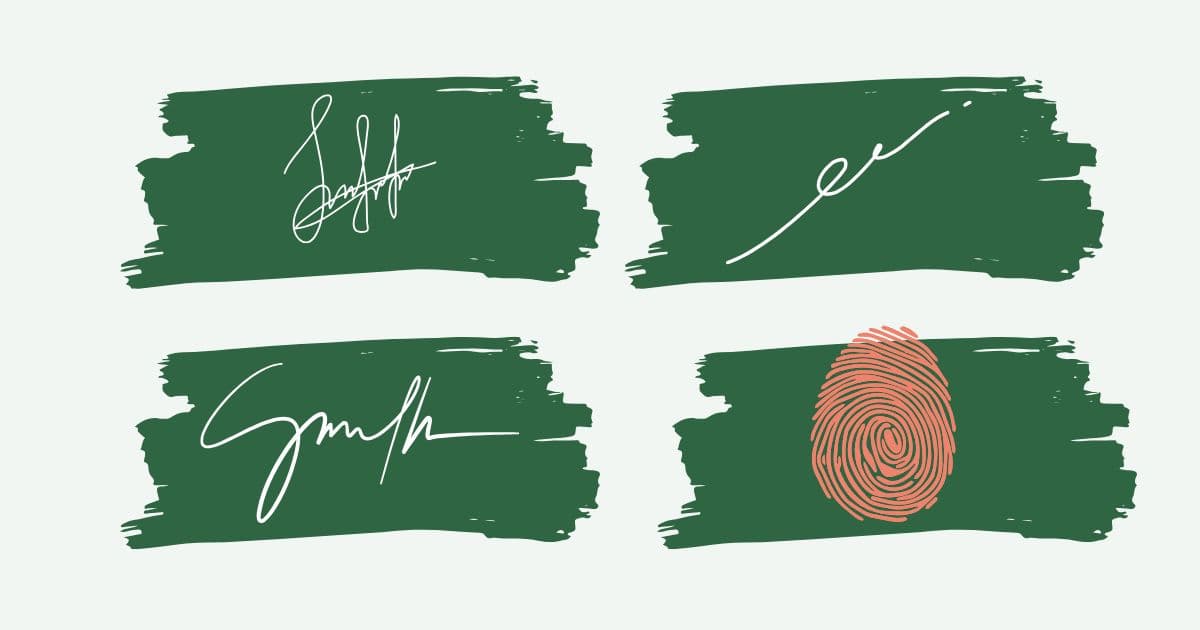
One of the things that surprises people when they start looking into signature law is how many valid types of signatures there actually are. The world of signatures is considerably broader than "cursive versus print." Here's a practical rundown of the main types — and when each one is appropriate.
Cursive Signature
The classic flowing, connected-letter script that most people think of when they picture a signature. Cursive signatures range from elegant and legible to completely illegible — many of the most authoritative-looking signatures are entirely unreadable to anyone but the signer. Cursive signatures are still the most common form for formal documents, particularly in contexts where tradition carries weight: legal documents, financial instruments, official correspondence.
Printed Signature
A signature written in block or print letters rather than connected cursive. Printed signatures are often more legible than cursive ones and are perfectly valid. Some people use print for casual signing and cursive for formal documents, but legally there is no distinction.
Initials
Some people sign with their initials rather than their full signature. Initials are valid as signatures in most contexts, though some formal documents (mortgage agreements, wills, certain government forms) require a full signature. When signing a multi-page document, initials are commonly used on all pages except the final signature page, where a full signature is expected.
Stylized Symbols or Personal Marks
Plenty of people develop signature styles that incorporate decorative elements — flourishes, underscores, symbols, loops that don't correspond to any letter — mixed in with recognizable letter forms. These hybrid signatures are valid. Picasso's signature included a large Greek-style cross. John Hancock's famous oversized flourish extends far beyond any recognizable letters. The legal validity of a signature doesn't depend on it being legible or even letter-based.
X or Simple Mark
The historical fallback for those who cannot write. Still valid, particularly when witnessed. In modern practice, an X is rarely used for formal documents, but it remains a valid signature form in most jurisdictions.
Rubber Stamp or Facsimile Signatures
Commonly used by executives, government officials, and others who sign large volumes of documents. Courts have generally upheld rubber stamp signatures where the signer authorized the use of the stamp and the stamp was used on their behalf. Some financial instruments and negotiable documents have stricter requirements.
Electronic Signatures
A typed name, a drawn signature on a touchscreen, a click-to-sign button, or a cryptographic digital signature — all are legally valid under the ESIGN Act and UETA for most commercial and consumer transactions. Electronic signatures are increasingly the norm for routine business documents, and our complete guide to electronic signatures walks through every type, how they work legally, and when each format is appropriate.
Cool Signature Ideas: How to Design One You'll Actually Like
Here's a confession: a lot of people hate their signature. They signed something quickly in their teens, the style stuck, and now they're thirty-five years old scrawling the same anxious loop they invented under pressure in a high school office. If that's you, it's worth knowing that you can change it. More on that in a later section. But first — what actually makes a signature look good?
The most visually striking signatures tend to share a few characteristics, and none of them require elaborate calligraphic training.
Start with your initials. The most memorable signatures often lead with a bold, distinctive first letter — the kind that makes an immediate visual impression. Think about what the capital letter of your first name looks like in different scripts. Architectural? Looped? Angular? Play with it. The initial is the anchor of the signature; everything else can flow from it.
Control the size ratio. One technique used by many distinctive signatures is radical size contrast — a large, bold opening letter followed by smaller, faster letters. Barack Obama's signature features a dramatically outsized capital O and B. The contrast creates visual weight and makes the signature immediately distinctive even at a glance.
Use speed to your advantage. A signature that you write slowly will look careful and labored. A signature you write at natural writing speed looks fluid and confident. When you're designing a new signature, practice it slowly enough to control the letterforms — but the goal is a mark you can produce quickly and consistently.
Decide how much of your name to include. Some people sign their full first and last name in readable form. Others use first initial plus full last name. Others sign only their last name. Others create a stylized mark that suggests their initials without clearly spelling them out. There is no rule about completeness — the signature just needs to be consistent and identifiable as yours.
Consider a finishing flourish. A horizontal line extending from the last letter, a small loop underneath the body of the signature, or an encircling line — flourishes add visual distinctiveness and are harder to forge than a plain text signature. They're also a way to make a short name feel more substantial on the page.
Practice on paper first. Before you commit to a new style, write it fifty times. Does it feel natural? Does it look consistent across repetitions, or does it vary wildly? A good signature should be reproducible under conditions ranging from sitting at a desk to standing at a counter while someone stares at you impatiently.
The internet is full of "cool signature ideas" — fonts, calligraphic styles, and inspiration galleries if you want visual references. What makes any signature cool, though, is ultimately consistency and confidence. A simple signature written with deliberate self-assurance looks better than an elaborate one that looks uncertain.
Why Some People Still Choose Cursive (And Why Others Don't)
Cursive has its champions and its skeptics, and both sides have legitimate points. Understanding the arguments can help you decide what's right for your own signature — even if you ultimately decide that the traditional flowing script isn't for you.
The case for cursive signatures is partly aesthetic, partly historical, and partly practical.
Aesthetically, a well-formed cursive signature has an elegance that most printed alternatives can't quite match. The fluid connection between letters, the variation in stroke weight, the sense of a trained hand — there's a reason law firms, financial institutions, and heads of state have traditionally signed in cursive. It carries a visual authority that print doesn't, whether that authority is logically justified or not. In contexts where first impressions matter — signed artwork, formal correspondence, legal documents where you're meeting the other party for the first time — a polished cursive signature communicates a kind of professionalism by association.
Historically, cursive signatures function as a form of cultural continuity. Learning to sign your name in cursive connects you to centuries of written tradition, for whatever that's worth to you personally. Some people find that connection meaningful. Others find it sentimental at best.
Practically, cursive signatures have one genuine advantage: they tend to be harder to forge than printed signatures. A printed signature in block letters is easier to replicate by someone who has seen it once. A distinctive cursive signature — especially one with idiosyncratic flourishes and consistent personal quirks — is considerably more difficult to reproduce convincingly. This matters most in contexts where signature authentication is a concern.
The case against cursive is equally practical.
Cursive is increasingly being taught less thoroughly in schools, and many younger adults never developed fluent cursive writing skills. A forced cursive signature that doesn't come naturally produces an inconsistent, labored result — which is actually more problematic (from a forgery-detection standpoint) than a confident printed signature.
For people who do most of their signing on touchscreens, tablets, and digital signature platforms, the physical dynamics of drawing cursive with a stylus or finger are completely different from writing with a pen on paper. What looks like a graceful cursive signature on paper often becomes an awkward blob on a capacitive touchscreen. Print signatures tend to translate better to digital surfaces.
And as document signing has moved increasingly online, the signature style displayed on a signed PDF matters less than the cryptographic certificate and audit trail behind it. The visual appearance of an electronic signature is essentially cosmetic. The legal substance is in the metadata.
In short: if cursive comes naturally to you and you like the way it looks, use it. If it doesn't, don't pretend it does.
Can a Print Signature Be Just as Valid?
Yes, absolutely, and this needs a dedicated section because the question comes up constantly. People sign documents in print all the time — sometimes because they never learned cursive, sometimes because print is cleaner and more legible, sometimes because they're signing on a touchscreen and print is simply easier. In every case, the signature is valid.
The legal standard, as discussed earlier, is intent-based, not style-based. A printed name signed at the bottom of a contract is not less legally binding than a cursive name. What matters is that the signer applied the mark with the intention to authenticate the document.
In fact, there are contexts where a printed signature is actually preferable to cursive.
Legibility. Some legal and administrative contexts genuinely benefit from a legible signature. If you're signing a check, a printed name that matches the name on the account is sometimes cleaner for the bank's records. If you're signing a document that will be photocopied repeatedly or scanned into a document management system, a legible printed signature reproduces more cleanly than an ornate cursive one that was already difficult to read.
Consistency. People who print their signature tend to produce a more consistent result than people who write cursive hurriedly or under pressure. Signature consistency matters because banks and document examiners comparing a current signature against an older one look for consistency as a marker of authenticity.
Digital contexts. On touchscreens, tablets, and electronic signature platforms, printed signatures are often more practicable than cursive. The rendering of a printed signature tends to be cleaner on digital surfaces.
One nuance worth knowing: on some official government forms — particularly older IRS forms, certain passport applications, and some court filings — the instructions say "sign here" next to a line that implies a handwritten signature. These instructions do not specify cursive, and a legible printed signature satisfies the requirement. If you encounter a form that appears to require a "wet" (ink) signature, the format of that signature is almost never specified beyond that.
If you're curious about more edge cases — whether your signature needs to include your full name, whether you can use a shortened version, and what happens when your signing name doesn't match your legal name — our post on whether your signature has to be your name covers those questions in depth.
Electronic Signatures: Does Cursive Matter Online?
When you're signing a document through an electronic signature platform, the question of cursive versus print almost entirely dissolves. Here's why.
An electronic signature, as defined by the ESIGN Act, is "an electronic sound, symbol, or process attached to or logically associated with a contract or other record and executed or adopted by a person with the intent to sign the record." The visual representation of that signature — whether it looks like cursive, print, a click of a button, or a typed name — is functionally separate from its legal substance.
When you sign a document electronically, what actually creates the legal record is not the visual mark you see on the page. It's the metadata behind it: the timestamp, the IP address, the identity verification, the cryptographic certificate (in the case of digital signatures), and the audit trail that shows who signed, when, and from where. That audit trail is what you would present as evidence in a dispute — not the aesthetic appearance of the visual signature.
This means that on an electronic signature platform, choosing to display your signature as a cursive-style font versus a printed-style font is essentially a visual preference, not a legal one. Most platforms let you either type your name (in various font styles, some of which look like cursive) or draw your signature with a mouse, stylus, or finger. Either option is valid.
What electronic signature platforms do prioritize is the process of authentication: verifying that the person signing is who they claim to be. This can be done through email authentication (only the person with access to that email account receives the signing link), through ID verification (uploading a government ID), through SMS codes, or through more sophisticated biometric methods. For high-stakes documents, these authentication layers provide far stronger evidence of the signer's identity than a visually convincing cursive signature on a piece of paper.
So if you're transitioning from paper signing to digital signing and you're worried about whether your electronic signature "counts" without being in cursive — it does, completely, and the legal protections around it are in many ways stronger than those around a handwritten signature with no accompanying audit trail.
For a deeper look at the full legal framework around electronic signatures, including which types of documents can and cannot be signed electronically, our complete guide to electronic signatures is the comprehensive resource.
Famous Signatures Throughout History (And What They Tell Us)
The history of famous signatures is essentially a history of people ignoring the unwritten "rule" that signatures should be conventional, legible, and reserved. The most iconic signatories in history tended to do exactly the opposite — and in doing so, they accidentally told us quite a lot about what signatures really are.
John Hancock is the most famous American signatory, and for good reason — his signature on the Declaration of Independence is enormous. The popular myth is that he signed it large enough for King George to read without his spectacles. Whether or not that's true, the practical lesson is that Hancock understood the signature as a statement as much as an authentication. The size and boldness of the mark communicated defiance, commitment, and identity all at once.
Napoleon Bonaparte signed with an illegible looping mark that devolved progressively through his life from something approaching his name to a nearly abstract symbol. By the later years of his reign, his signature was entirely unreadable — and entirely recognizable. It had become a personal seal in functional terms, even though it was applied with a pen.
Queen Elizabeth II maintained a beautifully formal signature throughout her reign: "Elizabeth R" (the R standing for Regina, Latin for queen). The formality of the signature matched the formality of her role. The signature functioned as a symbol of the Crown as much as an authentication of any individual's intent.
Albert Einstein had a surprisingly unremarkable signature for such a remarkable person — a modest, somewhat angular rendering of his name in a hybrid print-cursive style. Nothing as flashy as Hancock or as abstracted as Napoleon. Which perhaps tells you that great signature style and great intellect are entirely uncorrelated.
Salvador Dalí signed his name with a stylized flair appropriate to his artistic persona, and reportedly obsessed over the calligraphic quality of his signature the way other artists obsess over their work. For Dalí, the signature was a final artistic gesture.
What do all of these examples have in common? None of them were in standard cursive. None of them were "correct" by any formal standard. All of them were valid. All of them were distinctive. And all of them communicated something about the person who made them — which is exactly what a good signature should do.
The conclusion you can draw from the full historical sweep: there is no single right way for a signature to look. There is only the consistent, intentional mark that you have decided represents you.
How to Change Your Signature Legally
One of the most liberating things to learn about signatures is that you can change yours at any time. There is no law requiring you to use the same signature for life, no registration process for personal signatures, and no paperwork required to simply stop writing one signature and start writing another. You declare a new signature by using it, consistently, going forward.
That said, there are practical considerations that make signature changes more or less smooth depending on your circumstances.
The practical steps for changing your signature:
Step 1: Design your new signature. Use the principles in the earlier section on cool signature ideas. Practice your new signature until you can reproduce it consistently — at least fifty repetitions under varying conditions (sitting, standing, hurrying, calm) before you commit to using it officially.
Step 2: Update your bank accounts. Your bank maintains a signature card that documents your authorized signature. If your new signature differs significantly from the one on file, you may have checks or withdrawals questioned. Contact your bank to update your signature card — this is typically a quick in-branch process.
Step 3: Update government IDs and passports. Your driver's license and passport both bear your signature. When you renew either document (or replace it for other reasons), you can sign with your new signature. Most agencies do not allow you to update just the signature on a current, valid ID — you typically need to wait for renewal.
Step 4: Update any other documents where your signature is on file. This might include financial accounts, legal agreements, employment paperwork, or other formal registrations. For high-stakes contexts, be consistent from the date of the change forward.
Step 5: Be consistent. The legal validity of your new signature depends primarily on your consistent use of it. If you alternate between old and new signatures, you create ambiguity about which is authorized. Pick the new signature and stick with it.
One important nuance: if you have previously signed contracts or legal documents with your old signature, those documents remain valid and enforceable. Changing your signature going forward does not retroactively affect agreements you've already signed. It simply means that your authorized signature, from this point on, is the new one.
For a full exploration of the topic, including how courts handle inconsistent signatures and what to do when someone questions whether a signature is authentic, our post on whether you can change your signature covers the legal territory in detail.
Sign Your Documents Online with Dochives
Everything we've discussed in this guide — the legal flexibility around signature format, the irrelevance of cursive as a formal requirement, the shifting landscape of electronic and digital authentication — all points to the same practical conclusion: the most important thing about signing a document is not how your signature looks, but that the signing process creates a clear, reliable, tamper-evident record of your intent.
Paper signing struggles with this. A handwritten signature on a paper document, cursive or otherwise, tells you very little on its own: who was in the room, whether they were signing voluntarily, whether the document had been altered before or after signing, whether the signature was forged. Establishing those facts requires witnesses, notaries, or document forensic analysis — all of which are expensive and slow.
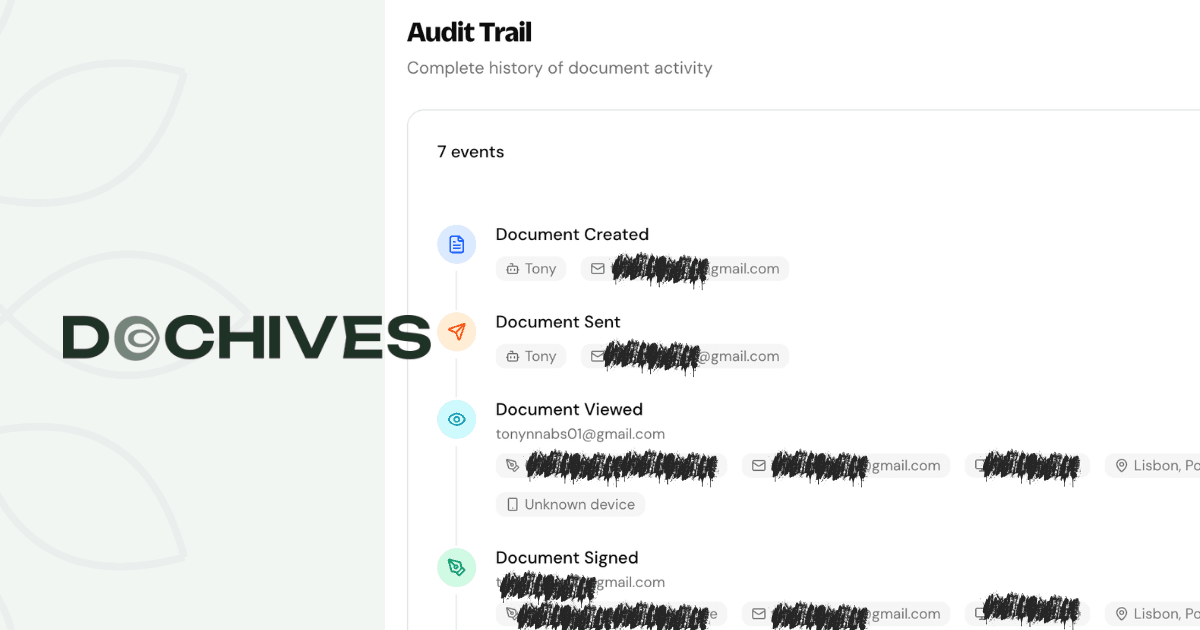
Electronic signing through a platform like Dochives solves all of this automatically. When you sign a document through Dochives, the system creates a timestamped record of every step: when the document was created, when the signing link was sent, when the recipient opened it, when each signature was applied, and from what device and location. That audit trail is generated automatically and stored securely alongside the document. If a dispute ever arises about whether the document was signed, or when, or by whom, you have a complete, verifiable digital record — far more robust than a piece of paper with a signature on it.
The visual appearance of your electronic signature in Dochives is up to you. You can type your name and choose from several font styles, draw your signature on screen, or upload an image of your existing handwritten signature. Cursive-style options are available if you want the traditional look. Print options are available if you prefer clarity. The legal weight of the signed document is identical either way.
What you gain by moving your document signing online is time, security, and accessibility. You can send a document for signature from anywhere and receive a completed, executed agreement within minutes. You do not need to print, scan, or maintain paper filing systems. You can access any signed document instantly, from any device, without digging through filing cabinets.
There is also a professional dimension that matters for anyone who works with clients or counterparties. Sending a professionally formatted document through a clean, intuitive signing platform creates a better client experience than emailing a PDF and asking someone to print, sign, scan, and email it back. It signals organization and modernity — the same kind of signal that a well-designed signature has always sent, just updated for 2026.
Ready to get your documents signed the right way? Try Dochives free and see how much faster professional document signing can be.