What Is Signature Forgery? Understanding the Meaning of a Forged Signature
Signature forgery is the act of signing someone else's name — or altering an existing signature — without that person's permission, with the intent to deceive. In plain terms: if you sign a document pretending to be someone you're not, or you doctor a signature to make it look like it belongs to someone else, that's forgery. It's not a gray area. It's fraud, and in most jurisdictions, it's a criminal offense with real legal consequences, not just a slap-on-the-wrist civil matter.
So what separates a forged signature from a legitimate one? Authorization. That's really the whole ballgame. An authorized signature — even a messy, illegible signature — is legally valid because the person signing actually intends to be bound by it and has the right to sign. I've seen contracts where the signature looks like a toddler scribbled on an Etch A Sketch, and yet it holds up perfectly fine in court, because the signer meant to sign and had the authority to do so. Legibility isn't the legal standard. Intent and consent are. You can read more about what actually makes a signature "official" in our post on what is a wet signature, which breaks down the traditional pen-and-paper standard that courts still often reference.
Forgery, by contrast, strips away that consent entirely. Think of it this way: a signature is basically a stand-in for a person saying "yes, I agree to this." Forgery is putting words in someone's mouth they never said. Maybe a business partner signs a loan agreement on behalf of a co-owner without asking. Maybe an employee scans and pastes a boss's signature onto an invoice to push a payment through. Maybe someone literally traces a signature from an old document onto a new one. All of these fall under the meaning of a forged signature, regardless of how convincing the copy looks.
I get asked "can someone forge my signature and get away with it?" more often than you'd think — usually from small business owners worried about vendor contracts or employees with access to sensitive paperwork. The honest answer is that forgery does happen, and detecting it can be tricky with paper documents, especially when signatures are already inconsistent or illegible to begin with. That inconsistency is actually part of why forgery is hard to prove sometimes — if your normal signature already looks different every time you sign, how do you demonstrate a particular instance wasn't yours?
This is one of several reasons more businesses are shifting away from handwritten signatures altogether. If you're weighing your options, our related read, Wet Signature vs Electronic Signature: Which Do You Need?, is worth a look. According to the FBI's guidance on fraud, forged documents remain a persistent tool in financial fraud schemes, which is exactly why understanding what forgery actually looks like matters before it happens to you.
Forgery vs. Unauthorized Signing vs. Identity Theft: Key Legal Distinctions
If you've ever asked yourself "wait, is this actually forgery, or just someone overstepping their bounds?" — you're not alone. These terms get thrown around interchangeably, but the law treats them very differently, and knowing the distinction matters if you ever need to report a problem or defend yourself against one.
Let's start with the core difference: forgery requires intent to deceive. Under most state laws, forgery happens when someone creates, alters, or signs a document with the specific purpose of passing it off as authentic when it isn't. The Legal Information Institute at Cornell Law School defines it as making a false writing with intent to defraud — that intent element is what separates a crime from a mistake.
Unauthorized signing, on the other hand, doesn't always involve deception. Picture this: your business partner signs a contract on your behalf because you're traveling and can't be reached, believing it's fine because you've done this before informally. There's no attempt to trick anyone — everyone involved knows who actually signed. But if you never gave that person authority to sign for you, it's still legally invalid. It might not rise to criminal forgery, but it can absolutely void a contract or trigger a civil dispute over authority and agency law. Courts look at whether the signer had actual or apparent authority, a concept rooted in basic agency principles you'll find explained in resources like the Uniform Commercial Code commentary on signatures.
Identity theft is a different animal altogether — it's broader than a single signature. The Federal Trade Commission defines identity theft as using someone's personal information without permission, typically to open accounts, secure loans, or make purchases in their name. Forging a signature can be one piece of an identity theft scheme, but identity theft usually involves stolen Social Security numbers, financial data, or other credentials — not just a copied signature on one document.
So why does this matter for you as a business owner? Because the legal remedy — and the urgency — changes depending on which category you're dealing with. Forgery is typically a criminal matter you report to law enforcement. Unauthorized signing might just mean renegotiating or voiding a contract through civil channels. Identity theft demands immediate action with your bank, credit bureaus, and possibly the FTC.
One thing all three share: sloppy documentation makes them harder to prove or disprove. An illegible signature might raise questions about authenticity, but illegibility alone isn't evidence of forgery — plenty of legitimate signatures are messy scrawls. What actually protects you is a clear audit trail: timestamps, IP addresses, and identity verification steps that show exactly who signed what, and when.
Common Methods Used to Forge a Signature
If you've ever wondered "how would someone even forge my signature?", the answer is usually a lot less high-tech than you'd think. Most forgers aren't master criminals — they're relying on a handful of tried-and-true techniques that have been around since long before digital documents existed. Understanding these methods matters because each one leaves different clues, and knowing what to look for can help you catch a forged signature before it costs you money or a contract dispute. Let's walk through the four most common approaches.
Tracing
Tracing is the oldest trick in the book, literally. Someone gets hold of a genuine copy of your signature — maybe from an old check, a delivery receipt, or a document you signed years ago — and places it under a blank sheet or holds it up to a light source to trace over the shape. The result often looks eerily close to your real signature at a glance, but tracing tends to produce telltale signs under closer inspection: unnaturally slow, shaky pen strokes, hesitation marks, or unusual pressure points where the forger had to stop and reposition. Forensic document examiners, including those trained by organizations like the American Board of Forensic Document Examiners, are specifically trained to spot these micro-tremors that a genuine, confidently written signature simply doesn't have.
Freehand Imitation (Simulation)
This is where someone studies your signature — sometimes for hours — and then tries to reproduce it from memory, without tracing. It's harder to pull off convincingly than tracing, which sounds counterintuitive, but freehand forgeries often look more natural because the forger writes at a normal speed rather than tracing slowly. The catch? Even skilled forgers can't perfectly replicate the subconscious muscle memory that makes your real signature yours. Letter proportions, slant, and the rhythm of connected strokes tend to differ subtly, which is exactly what handwriting analysts look for when authenticating a signature in disputes.
Cut-and-Paste
With physical documents, this used to mean literally cutting a signature from one page and pasting it onto another, then photocopying the result to hide the seams. In the digital age, it's evolved into something far sneakier: someone lifts a scanned or photographed signature image from one document — an email attachment, a PDF, a social media post — and inserts it into an entirely different document. It's fast, requires zero artistic skill, and can be shockingly convincing if the copy quality is decent. This is one of the biggest reasons an illegible signature or a static image signature is so easy to misuse once it's floating around unprotected.
Digital Manipulation
This is the modern frontier of signature forgery, and it's arguably the hardest to detect with the naked eye. Bad actors use photo editing software to alter existing signature images, generate synthetic versions, or even manipulate PDF metadata to make an unsigned document appear signed. The National Institute of Standards and Technology (NIST) has published extensive guidance on digital signature integrity precisely because verifying authenticity in electronic documents requires more than just eyeballing an image — it requires cryptographic verification and audit trails.
That's exactly why platforms built for secure e-signing matter so much. Instead of a static image anyone can copy, tools that log IP addresses, timestamps, and authentication steps make forgery dramatically harder to pull off — and far easier to prove if someone tries.
Why an Illegible Signature Can Be a Target for Fraud
Here's something most people never think about: the messier your signature, the easier it is for someone to fake it and get away with it. That scrawled, half-legible mark you've been using since high school? It might feel personal and unique to you, but to a forensic document examiner—or worse, a fraudster—it's often just a shape. And shapes are easy to copy.
Think about it this way. If your signature is a genuine attempt to write your name, a trained eye (or even a careful bank teller) can compare letterforms, spacing, and pressure points to spot inconsistencies. But if your signature has devolved into a squiggle, a loop, or a jagged line with no discernible letters, there's nothing concrete to compare it against. It becomes a moving target. One version might lean left, another might have an extra flourish, and a third might be rushed and half the size. When you can't even reproduce it exactly, how is anyone supposed to prove that a fraudulent version isn't yours?
This ambiguity is exactly what fraudsters exploit. According to the FBI's guidance on document fraud, inconsistency in identifying markers—signatures included—makes verification significantly harder for everyone in the chain: banks, notaries, business partners, and courts. If your signature already varies wildly from document to document, a forged version doesn't have to be a perfect match. It just has to be "close enough" to pass a quick glance, which is often all a busy clerk or automated system gives it.
There's a legal angle here too. In disputes over contracts, courts sometimes rely on handwriting analysis and forensic document examination to determine authenticity. But forensic examiners need a baseline—a consistent pattern of how you form your signature. If your signature is illegible and inconsistent, you're giving less evidence to work with, which can weaken your position if you ever need to prove a document was forged rather than genuinely signed by you.
I've heard from small business owners who assumed their chaotic signature was actually a security feature—"nobody can copy this mess," they'd say. But that logic backfires. A messy signature doesn't protect you; it removes the very thing that makes forgery detectable in the first place: a recognizable, repeatable pattern.
This is one of the reasons digital signing tools have gained so much traction. Platforms that use e-signature standards tied to authentication methods—like email verification, timestamps, and audit trails—don't rely on the visual shape of your signature at all. Instead, they create a verifiable record of who signed what, and when, removing the ambiguity altogether.
If you're tired of wondering whether your handwritten scrawl is helping or hurting you, it might be time to rethink how you sign documents entirely. Try Dochives free and see how much faster—and more secure—professional document signing can be: https://dochives.com
Legal Consequences of Signature Forgery
Let's get straight to it: forging a signature isn't just a bad business decision — it's a crime. In the U.S., signature forgery typically falls under both civil and criminal law, and depending on where you live, the penalties can range from a slap on the wrist to years behind bars. I've seen small business owners assume forgery is a "civil matter" they can settle quietly. That's rarely how it plays out once law enforcement gets involved.
Criminal Penalties
Most states classify forgery as a felony, especially when it involves financial documents, contracts, or property transfers. According to the Cornell Law School Legal Information Institute, forgery generally requires proof that someone falsified a document with the intent to defraud. That intent piece matters a lot — accidentally signing on the wrong line isn't forgery, but deliberately mimicking someone else's signature to gain something of value absolutely is.
Penalties vary widely. In some states, forging a signature on a low-value document might be charged as a misdemeanor, carrying fines and possibly a short jail stint. But forge a signature on a check, deed, or business contract worth thousands of dollars? You're likely looking at felony charges, which can mean multiple years in prison. Federal charges can also apply if the forgery crosses state lines, involves the U.S. mail, or touches federally regulated industries like banking — the FBI's white-collar crime division handles many of these cases.
Civil Penalties
Separate from criminal charges, the victim of a forged signature can usually sue for damages in civil court. This might involve recovering lost money, voiding a fraudulent contract, or seeking compensation for the fallout — think damaged credit, lost business deals, or reputational harm. Civil cases don't require the same "beyond a reasonable doubt" standard as criminal cases, so it's often easier for a wronged business owner to win a civil suit even if criminal charges never stick.
Here's the kicker: you can face both a criminal case and a civil lawsuit for the same act of forgery. One doesn't cancel out the other. I always tell entrepreneurs — if you suspect a signature on your contract was forged, don't assume it's "handled" just because someone went to jail. You may still need to pursue civil action to actually recover your losses.
Why Jurisdiction Matters So Much
Forgery laws aren't federal-only; each state defines and punishes it differently. Some states lump forgery in with fraud statutes, while others have standalone forgery laws with their own sentencing guidelines. If your business operates across multiple states — or internationally — this patchwork of laws can get complicated fast. What's a misdemeanor in one state could be a felony in another.
This is exactly why so many small businesses are moving away from wet-ink signatures altogether. Digital signing platforms create audit trails, timestamps, and identity verification steps that make forgery dramatically harder to pull off — and much easier to prove if it happens. If you're tired of wondering whether a signature is legitimate, try Dochives free and see how much faster — and safer — professional document signing can be.
How Forensic Experts Detect a Forged Signature
So how do you actually prove a signature is fake? It's not guesswork — it's a discipline. Forensic document examiners (sometimes called questioned document examiners) use a mix of microscopy, measurement, and pattern analysis to figure out whether a signature was written by the person it claims to be, or by someone else entirely. Think of it like a fingerprint analysis, except the "print" is the unique way your hand moves a pen across paper.
Line quality is where most examiners start. A genuine signature, even a messy one, flows. The pen speeds up and slows down in predictable places, pressure builds and releases naturally, and there's a rhythm to it — almost like handwriting has its own heartbeat. Forged signatures, especially ones drawn slowly or traced, tend to show hesitation marks: tiny tremors, pen lifts, or retouching where the forger stopped to check their work. Under magnification, these show up as wavy, uneven lines instead of the smooth, confident strokes of natural writing. The American Board of Forensic Document Examiners trains and certifies specialists specifically in spotting these micro-level inconsistencies.
Stroke sequence and letter formation matter too. Everyone builds their letters in a slightly different order — which stroke comes first in a capital "M," where the pen lifts between letters, how a loop closes. Examiners compare these habits against known, verified samples (called exemplars) from the real signer. If the sequence doesn't match across multiple genuine samples, that's a red flag.
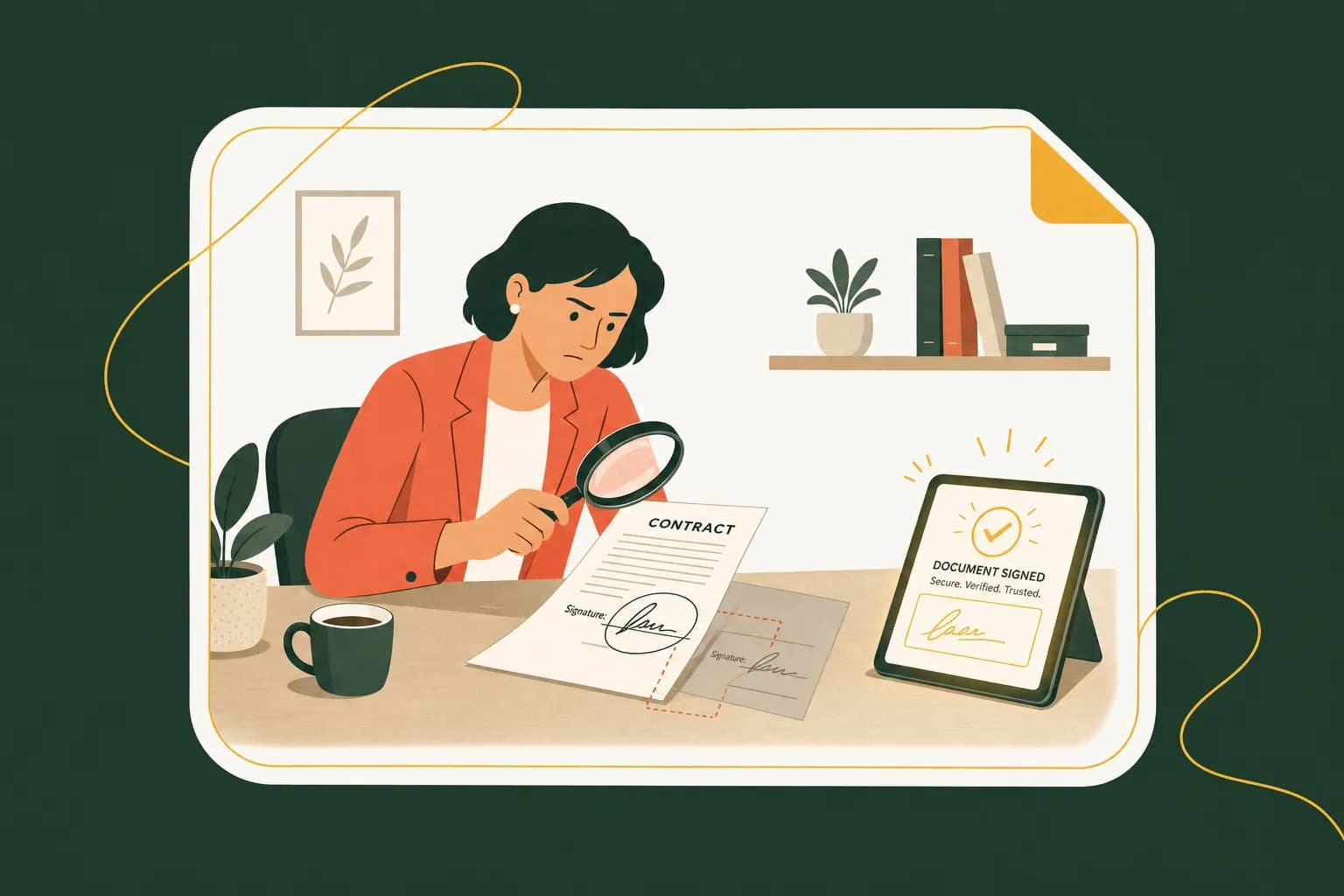
Pressure patterns and indentation get studied with tools like the Electrostatic Detection Apparatus (ESDA), which can reveal impressions left on paper underneath the signed page — useful for uncovering tracing or overwriting. Infrared and ultraviolet imaging can also expose ink differences invisible to the naked eye, which matters if someone forged a signature and then went back to "fix" it.
Examiners also lean on the idea that every physical interaction leaves a trace — a version of Locard's exchange principle, often cited in forensic science. Applied to documents, it means a forger almost always leaves something behind: a slightly wrong slant, an unnatural pause, ink that doesn't quite match.
Courts take this seriously. Expert testimony from a qualified document examiner has been accepted in U.S. federal and state courts for decades, and the analysis often follows standards similar to those outlined by the National Institute of Justice for forensic evidence handling.
Here's the honest takeaway: catching a forgery after the fact is possible, but it's slow, expensive, and stressful. It's far better to prevent the dispute altogether. That's exactly why more small business owners are moving away from wet-ink signatures and toward verified e-signature platforms that timestamp, authenticate, and audit every signing event automatically. Try Dochives free and see how much faster — and more defensible — professional document signing can be.
What to Do If You Suspect Your Signature Was Forged
So you're staring at a document with your name scrawled across the bottom, and something feels off. Maybe the loops are wrong. Maybe you simply never signed the thing. Whatever tipped you off, your gut is worth listening to here — and what you do in the next 48 hours can matter more than you'd think.
First, don't panic, but don't sit on it either. Signature forgery cases often hinge on timing. The longer you wait to act, the harder it becomes to prove you noticed the fraud promptly, and some legal claims — like disputing a fraudulent check under the Uniform Commercial Code, which many states have adopted — come with strict notification windows. Banks, for instance, typically want you to report unauthorized transactions within a set period, or you risk losing certain protections.
Step 1: Secure the Original Document
Don't sign anything new related to the dispute, and don't let the original document (or a copy of it) disappear. If it's a scanned or e-signed file, save the metadata, timestamps, and any audit trail associated with it. If it's physical, store it somewhere safe and avoid handling it more than necessary — you may need it for forensic analysis later.
Step 2: Gather Supporting Evidence
Start building a paper trail. Pull together:
- Genuine signature samples from the same time period (checks, IDs, past contracts)
- Any communication (emails, texts) that contradicts the forged document's claims
- Witnesses who can confirm your whereabouts or that you never agreed to the terms
- Bank or credit reports showing the fraudulent activity, if applicable — you can request a free copy through AnnualCreditReport.com, the only site authorized by federal law for free credit reports
Think of this like assembling a case file before you ever walk into a lawyer's office. The more organized you are upfront, the less time (and money) you'll spend explaining yourself later.
Step 3: Report It
Depending on what the forged document affected, you may need to file reports in multiple places:
- Local police — forgery is a crime, and a police report creates an official record.
- Your bank or credit card issuer, if financial accounts are involved.
- The Federal Trade Commission, via IdentityTheft.gov, which walks you through reporting identity-theft-related forgery and creates a personalized recovery plan.
- The FBI's Internet Crime Complaint Center (IC3.gov), if the forgery happened online or involved digital documents.
Step 4: Consult an Attorney
This isn't a step to skip. Forgery law varies by state, and an attorney can tell you whether you're looking at a civil dispute, a criminal matter, or both. They'll also know how to formally challenge the document's validity in court if it comes to that.
Step 5: Prevent It From Happening Again
Once the dust settles, it's worth rethinking how you sign things in the first place. Tools like Dochives add verification layers — timestamps, audit trails, identity checks — that make forgery far harder to pull off and far easier to disprove if it's ever attempted. Try Dochives free and see how much faster, and safer, professional document signing can be.
How Electronic Signatures Reduce the Risk of Forgery
Here's the honest truth: a pen and paper never stood a chance against a determined forger. Handwritten signatures are, by nature, easy to study, easy to copy, and nearly impossible to verify after the fact. Electronic signatures flip that script entirely. Instead of relying on the shape of a scribble, e-signature platforms build a chain of digital evidence around every signing event — evidence that's far harder to fake and far easier to prove in court if something goes wrong.
Let's break down why that is.
Audit Trails Turn Guesswork Into Proof
When you sign a document by hand, there's no record of how it happened — just the ink on the page. Electronic signature platforms solve this by generating a detailed audit trail for every document. This log typically captures the signer's IP address, device information, timestamp, and each action taken during the signing process, from opening the document to applying the final signature.
Think of it like a security camera pointed at every signature. If a dispute ever arises — say, someone claims "I never signed that" — the audit trail provides a timestamped, sequential record that's difficult to argue with. Compare that to a forged handwritten signature, where forensic document examiners often have to rely on subjective handwriting analysis, ink aging, and pressure patterns just to form an educated opinion.
Authentication Confirms Who's Really Signing
Anyone can scrawl a signature that resembles someone else's if they practice enough. But electronic signature platforms add layers of identity verification that a pen simply can't replicate. Depending on the platform and the sensitivity of the document, this might include email verification, SMS one-time passcodes, knowledge-based authentication questions, or even government ID checks.
The U.S. General Services Administration and other federal bodies have leaned into these verification standards for electronic transactions precisely because they close the gap that forgers exploit — namely, the lack of any real identity check at the moment of signing.
Encryption Locks the Document Down
Once a document is signed electronically, tamper-evident technology seals it. Any attempt to alter the content, the signature, or the metadata after the fact is flagged immediately, often invalidating the document's certificate of completion. This is fundamentally different from paper, where someone could theoretically alter terms after a signature was applied and hope no one notices.
The National Institute of Standards and Technology has published extensive guidance on cryptographic standards that underpin this kind of document security, and reputable e-signature providers build their systems around these frameworks.
The Legal Backbone Matters Too
Electronic signatures aren't just technically secure — they're legally recognized. Under the U.S. ESIGN Act, electronic signatures carry the same legal weight as handwritten ones, provided proper consent and record-keeping standards are met. That legal backing, paired with airtight digital evidence, is exactly why more small businesses are moving away from pen-and-paper contracts altogether.
If you're tired of wondering whether that signature on your contract is really legitimate, it might be time to see the difference for yourself. Try Dochives free and see how much faster — and safer — professional document signing can be.
Best Practices to Protect Your Business from Signature Forgery
Let's be honest: you can't spend your days scrutinizing every signature like a handwriting examiner. You've got clients to serve, invoices to send, and a business to run. But a few smart habits, baked into how you handle contracts and approvals, can shut the door on most forgery attempts before they ever start.
Start with identity verification, not blind trust. If you're sending a contract to a new client or vendor, don't just email a PDF and hope for the best. Use a signing platform that requires identity checks — things like email verification, SMS authentication codes, or even knowledge-based questions before someone can access and sign a document. The Federal Trade Commission has repeatedly warned small businesses that weak verification processes are one of the easiest entry points for fraud. Think of identity verification as the lock on your front door — it won't stop a determined burglar, but it stops nearly everyone else.
Ditch the illegible scrawl for something verifiable. I get it, cursive signatures feel personal and professional. But an illegible signature is genuinely harder to defend in a dispute because there's less unique detail for a forensic document examiner to analyze. Electronic signatures solve this neatly by pairing your mark with an audit trail — timestamps, IP addresses, and device data that a handwritten signature simply can't provide.
Store signed documents securely, not in your inbox. How many contracts are sitting in your email right now, unencrypted, searchable, and one phishing attack away from being copied? Secure cloud storage with access controls and encryption is non-negotiable for small businesses. The National Institute of Standards and Technology offers guidance on document security practices that even solo freelancers can apply without needing an IT department.
Use tamper-evident seals and audit trails. This is where a lot of small business owners get pleasantly surprised. Modern e-signature tools embed tamper-evident seals directly into the document — if even a single character changes after signing, the seal breaks and flags the alteration. It's the digital equivalent of a wax seal on an old letter, except it actually works every time.
Set internal policies, even if it's just you. Decide who can sign what, above what dollar amount, and require a second check for high-value contracts. Freelancers often skip this step because "it's just me," but a clear policy protects you if a client later claims a document was altered or unauthorized.
None of these steps require a legal team or a big budget. They just require a platform built with security in mind from the start.
Try Dochives free and see how much faster — and safer — professional document signing can be: https://dochives.com
People Also Ask
What Is Considered Signature Forgery Legally?
Legally, signature forgery means signing someone else's name (or altering a document) without their permission, with the intent to deceive or defraud. The key word is intent — an honest mistake, like a spouse signing on someone's behalf with implied consent, usually doesn't count. According to Cornell Law School's Legal Information Institute, forgery statutes typically require that the forged document have some legal significance, meaning it could actually cause harm if accepted as genuine. Since forgery laws vary by state, it's worth checking your local statutes if you're dealing with a specific case.
How Can You Tell If a Signature Has Been Forged?
You can often spot a forged signature by looking for shaky, hesitant pen strokes, unusual pen lifts in the middle of letters, or a signature that looks "too perfect" compared to how someone normally signs. Inconsistent slant, pressure, or spacing compared to known authentic samples is another red flag. That said, subtle forgeries can fool the untrained eye — which is exactly why forensic document examiners exist for high-stakes disputes.
What Should You Do If Someone Forges Your Signature?
First, don't sign anything else or make any statements until you've documented what happened — take photos of the forged signature and gather any related paperwork. Report it to local law enforcement and, if a financial account or contract was involved, notify the bank or business immediately in writing. You may also want to consult an attorney, since forgery can trigger both criminal charges and civil remedies depending on the damages involved.
If you're tired of worrying about who's actually signing your documents, switching to a secure e-signature platform is one of the simplest fixes. Try Dochives free and see how much faster — and safer — professional document signing can be.