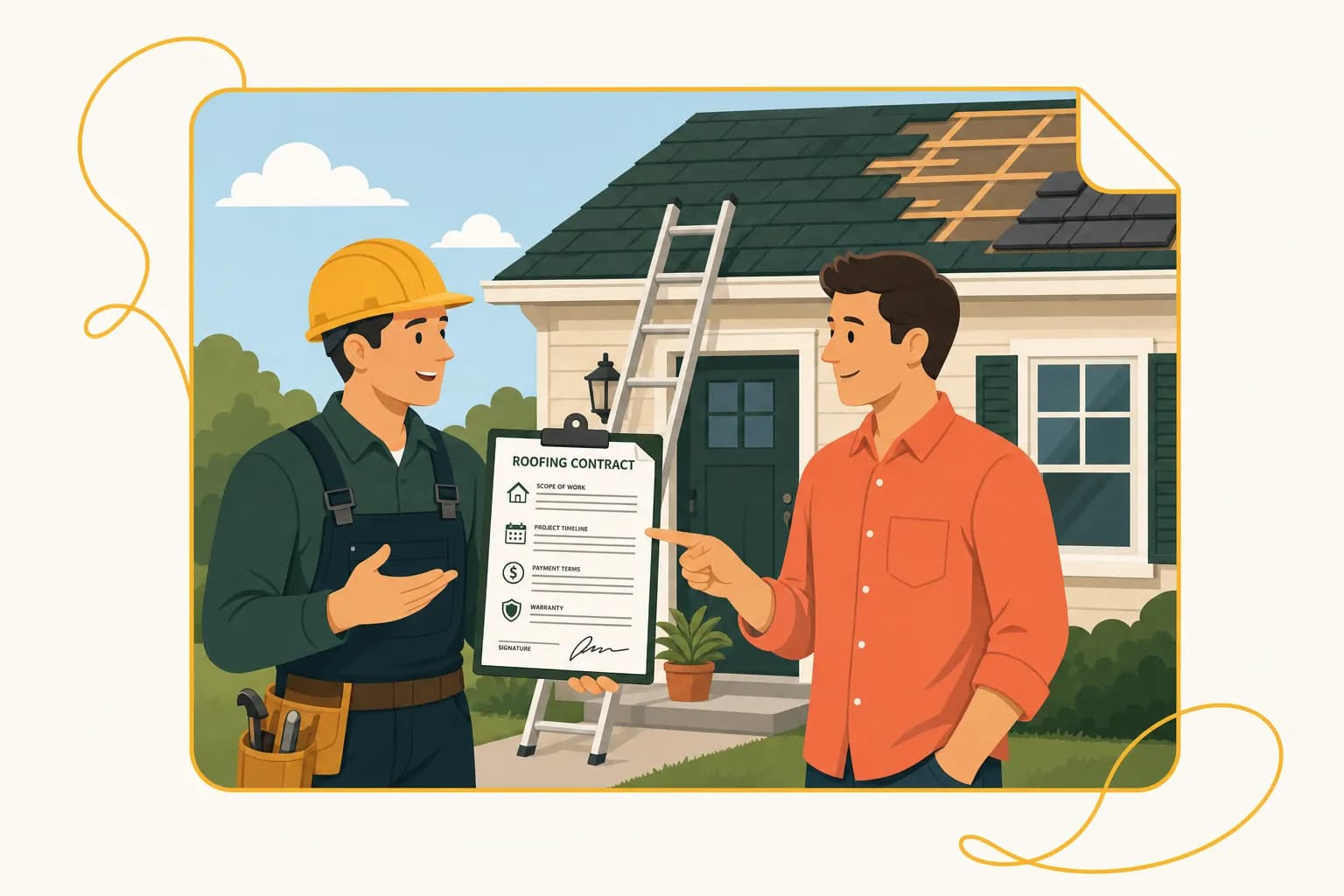
What Is a Roofing Contract Template and Why You Need One
A roofing contract template is a pre-formatted, fill-in-the-blank document that spells out every detail of a roofing job — scope of work, materials, cost, payment schedule, timeline, and warranty terms — so both the contractor and the homeowner know exactly what they're agreeing to before a single shingle gets touched. Think of it as the blueprint for the business side of the job, not just the roof itself. If the framing crew wouldn't start without a set of plans, why would you start a roofing project without one?
I've talked to enough roofing contractors to know that the jobs that go sideways almost always trace back to one thing: nothing was written down clearly enough. A homeowner assumed gutters were included. A contractor assumed a 50% deposit was standard. Someone thought "premium shingles" meant a specific brand, and someone else thought it just meant "the good ones." A solid roofing agreement template closes those gaps before they ever open up.
Here's why that matters for you, whether you're swinging the hammer or writing the check.
For contractors, a written contract is protection. It documents what you agreed to do, what materials you're using, and what the homeowner owes you — and when. If a customer tries to withhold payment over a disagreement, your signed contract is your evidence. The Federal Trade Commission's guidance on home improvement contracts even points out that clear written agreements are one of the best defenses against payment disputes and misunderstandings. Beyond that, many states legally require written contracts for home improvement work above a certain dollar amount, so skipping one isn't just risky — it might not be optional.
For homeowners, the contract is your safety net. Roofing is expensive, and a bad job can mean leaks, mold, and thousands in repairs down the line. A proper contract locks in pricing so you're not blindsided by "surprise" charges, sets a realistic timeline, and outlines what warranty coverage you're getting on both labor and materials. The Better Business Bureau regularly warns homeowners to avoid any contractor who won't put things in writing — that reluctance is often a red flag.
A good roofing contract also needs the basic legal building blocks to actually hold up — the same ones that apply to any binding agreement (see: What Are the Elements of a Valid Contract?). And a fill-in-blank printable roofing contract template handles that structure for you, so you're not starting from a blank page every time.
If you're managing multiple types of service agreements, it's worth building a small library — similar templates exist for other trades, like the Free Lawn Care Contract Template or the Free Construction Contract Template, or for broader categories like Free Professional Services Contract Templates.
Free Roofing Contract Template
Download this free template and customize it for your needs.
Key Elements of a Roofing Agreement Template
A solid roofing agreement template isn't just a formality — it's the document that protects your business when a customer questions your invoice or a supplier delivers the wrong shingles. So what actually needs to be in there? Let's break down the pieces that separate a bulletproof roofing contract form from a flimsy one-pager that leaves you exposed.
Scope of work comes first, and it's arguably the most important section. This is where you spell out exactly what you're doing — tear-off or overlay, square footage, roof pitch, and any structural repairs you've identified. Vague language like "repair roof as needed" is a recipe for disputes. Instead, write something like "remove existing three-tab shingles down to the deck, inspect and replace up to 4 sheets of plywood decking if damaged, install synthetic underlayment." The more precise you are, the less room there is for a homeowner to claim you didn't do what they expected.
Materials specifications should follow right behind it. List the manufacturer, product line, color, and warranty class of shingles, along with underlayment type, flashing material, and ventilation components. If you're using architectural shingles rated for high wind, note the wind rating — this matters for both performance and insurance purposes. The National Roofing Contractors Association offers guidance on material standards that's worth referencing if you want your specs to hold up to scrutiny.
Labor costs and payment terms need their own clearly defined section. Break down labor separately from materials, even if you're quoting a flat project price — it makes change orders and insurance claims far easier to handle later. Include your payment schedule: deposit amount, progress payments tied to milestones (like completion of tear-off or dry-in), and the final payment due upon completion. Many states cap how much deposit a contractor can legally collect upfront, so it's worth checking your state's consumer protection rules before you finalize this section.
Beyond those three pillars, a few more elements round out a truly thorough template:
- Project timeline — start date, estimated duration, and language addressing weather delays.
- Permits and code compliance — who pulls the permit, and confirmation the work meets local building codes.
- Warranty terms — both manufacturer warranty and your own workmanship guarantee, spelled out separately.
- Insurance and liability — proof of your liability coverage and workers' comp, which reassures the homeowner and protects you.
- Cleanup and disposal — who hauls away old shingles and debris.
- Change order process — how you'll document and price any scope changes discovered mid-project.
- Dispute resolution — mediation or arbitration clause, so disagreements don't automatically end up in court.
Missing even one of these can turn a routine job into a costly headache. If you want a template that already has every one of these fields built in and ready to customize, try Dochives free and see how much faster professional document signing can be.
Payment Schedule and Deposit Terms for Roofing Projects
Let's talk money — because if there's one part of a roofing contract that causes headaches, it's the payment schedule. You've probably heard horror stories about contractors who took a big deposit and disappeared, or homeowners who withheld final payment over a minor dispute. A clear, well-structured payment schedule protects you from both scenarios, and honestly, it's one of the easiest parts of your roofing agreement template to get right once you understand the logic behind it.
Why Structure Matters More Than the Amount
Most disputes I've seen in this industry aren't really about how much money changes hands — they're about when. If your roofing contract forms don't spell out payment timing tied to specific milestones, you're setting yourself up for awkward conversations mid-project. Think of your payment schedule like a relay race: each payment is a baton pass tied to a completed leg of work. Miss that handoff structure, and everyone starts running in different directions.
The Standard Deposit Structure
A reasonable deposit typically runs between 10% and 30% of the total project cost, though this varies by state and by the size of the job. Many states actually cap contractor deposits by law — the Federal Trade Commission and various state consumer protection offices publish guidance on this, so it's worth checking your local rules before you finalize numbers. A deposit covers your initial material costs and locks in the customer's commitment. It shouldn't be so large that it removes your incentive to finish the job properly.
Breaking Payments Into Milestones
For most roofing jobs, a three-payment structure works well:
- Deposit (10–30%) — collected before work begins, often used for materials and permitting.
- Progress payment (30–50%) — collected once tear-off and underlayment are complete, or at a defined midpoint.
- Final balance (remaining amount) — due upon completion and passing of final inspection.
For larger commercial roofing projects, you might add a fourth milestone tied to material delivery, since shingles, membrane, or metal panels can represent a huge chunk of upfront cost. The National Roofing Contractors Association offers useful benchmarks on typical project phases if you want a reference point.
Final Balance and Lien Waivers
Your fill in blank printable roofing contract template should include a line specifying that final payment is due within a set number of days after project completion — five to fourteen days is common. It's also smart to require a signed lien waiver at final payment. This protects the homeowner from any claims by subcontractors or suppliers who weren't paid, and it protects you by formally closing out the job. The U.S. Small Business Administration has resources on cash flow management that pair well with this kind of milestone billing.
Keeping Cash Flow Predictable
Here's the real point of all this structure: predictability. When your payment schedule matches your labor and material outlays, you're not floating costs out of pocket for weeks. That's the difference between a roofing business that grows steadily and one that's constantly scrambling for working capital.
Once you've nailed down your payment terms, the next step is making sure they're captured in a document that's easy to send, sign, and track. Try Dochives free and see how much faster professional document signing can be: https://dochives.com
Warranty and Workmanship Guarantee Clauses
If there's one part of a roofing contract that separates the pros from the fly-by-night operators, it's the warranty section. I've seen too many disputes start because someone assumed "warranty" meant one thing, and the other party assumed something completely different. Your roofing agreement template needs to spell this out in plain language, because a vague warranty clause is basically no warranty at all.
Let's start with the basics. There are actually two distinct types of warranties you're dealing with on any roofing job, and your contract forms should address both separately.
Manufacturer's material warranty covers the shingles, underlayment, flashing, and other products themselves. This warranty comes from the manufacturer, not you, and it typically ranges from 20 years to a lifetime depending on the product line. Your job as the contractor is simply to disclose what's covered and point clients toward the manufacturer's documentation — you're not on the hook for defective materials, but you should still note this in writing so nobody's confused later.
Workmanship warranty is the one you actually control, and it's the one that protects your reputation. This covers installation errors — things like improper flashing, poor ventilation, or nail pops that show up because of how the roof was put on, not because of a bad batch of shingles. Most contractors offer somewhere between two and ten years on workmanship, though the length really depends on your confidence in your crew and your local market standards. The National Roofing Contractors Association has some solid guidance on industry norms if you're trying to figure out where to land.
Here's where your fill-in blank printable roofing contract template earns its keep: it should have dedicated fields for warranty duration, what's specifically excluded (storm damage, tree limbs, foot traffic from other trades), and the process for filing a claim. Don't just write "workmanship guaranteed" and call it a day. That phrase means nothing in a dispute. Instead, spell out exactly what triggers a warranty repair versus what counts as normal wear and requires a separate service call.
I'd also recommend including a clause about transferability — can the warranty pass to a new homeowner if the property sells? This matters more than people think, especially for buyers doing due diligence, and it's the kind of detail the Consumer Financial Protection Bureau flags as worth clarifying in any home improvement contract.
One more thing: think about how you'll document warranty terms so there's no "he said, she said" later. A signed, dated agreement with clear warranty language protects you just as much as it protects your client. That's honestly where having a reliable e-signature system pays off — you want both parties locking in these terms with a paper trail, not a handshake and good intentions.
Try Dochives free and see how much faster professional document signing can be: https://dochives.com
Timeline, Start/Completion Dates, and Weather Delay Provisions
Let's be honest: roofing is one of the few trades where Mother Nature gets a vote on your schedule. You can have the best crew in town, a fully permitted job, and materials sitting in the driveway — but if a thunderstorm rolls through for three days straight, none of that matters. That's exactly why your roofing contract template needs a timeline section that's realistic, not aspirational.
Start with a specific start date, not a vague window. I know it's tempting to write "sometime next week" because you genuinely don't know what Tuesday's forecast will look like. But a fill-in-blank printable roofing contract template should have a hard start date field, even if you later amend it. Vague timelines are one of the top sources of customer complaints in the roofing industry, and they're the kind of thing that ends up in a dispute or, worse, a complaint filed with your state's consumer protection office.
Set a completion date, but build in flexibility. Most roofing contract forms include a "substantial completion" clause — meaning the roof is functionally done (weathertight, shingled, flashed) even if minor punch-list items like gutter touch-ups remain. I'd recommend estimating a completion window rather than a single day. For a standard asphalt shingle reroof, 1-3 days is common; for larger or more complex jobs (slate, tile, complicated dormers), a week or more isn't unusual. The National Roofing Contractors Association has good general guidance on project scoping that can help you calibrate expectations for different roof types.
Now, the weather clause — this is the part people skip and shouldn't. Your template needs explicit language stating that the project timeline is subject to delay due to conditions outside your control: rain, high winds, extreme heat, snow, or lightning risk. The Occupational Safety and Health Administration actually has specific guidance on when roofing work becomes unsafe due to weather, which is worth referencing if a customer pushes back on a delay. You're not being difficult — you're keeping your crew safe and follow federal workplace safety recommendations.
I always suggest adding a line like: "Contractor is not liable for delays caused by weather conditions that make roofing work unsafe or that violate manufacturer installation guidelines." That second part matters too — shingle manufacturers often specify minimum temperatures for proper adhesive sealing, and installing outside that range can void your warranty. Checking your local NOAA forecast data before each phase isn't overkill; it's just smart project management.
Finally, build in a communication commitment: how will you notify the homeowner of a delay, and how quickly? Even a simple "we'll call or text within 24 hours of any schedule change" clause goes a long way toward keeping trust intact when the sky doesn't cooperate.
Want a roofing agreement template that already has these timeline and weather provisions built in? Try Dochives free and see how much faster professional document signing can be: https://dochives.com
Permits, Insurance, and Licensing Disclosures for Roofing Contractors
Here's something I've seen trip up even experienced contractors: you can have a beautifully written roofing agreement template with airtight payment terms and a rock-solid warranty clause, but if you skip the compliance disclosures, you're still exposed. Permits, insurance, and licensing aren't just paperwork to shove in a drawer — they're the section of your roofing contract forms that protects you legally and tells the homeowner you're not some fly-by-night operation with a magnetic sign on a pickup truck.
Let's start with licensing. Most states require roofing contractors to hold a specific license, and some even require a specialty roofing license separate from a general contractor's license. Your contract template should include a blank line for your license number and issuing state, right near your business name and address. Why does this matter so much? Because homeowners increasingly check license status before hiring — and reputable review sites and consumer protection agencies encourage it. The Federal Trade Commission's guidance on hiring contractors specifically tells consumers to verify licensing before signing anything. If your fill in blank printable roofing contract template already has that field ready to go, you're one step ahead of the homeowner's due diligence.
Insurance disclosure is next, and honestly, it's the section clients scrutinize most. You'll want space for two things: general liability insurance and workers' compensation coverage. General liability protects the homeowner's property if something goes wrong — a ladder through a window, debris damage to landscaping, that sort of thing. Workers' comp protects everyone if a worker gets hurt on a steep pitch (and roofing has one of the higher injury rates in construction, according to OSHA's data on falls in construction). Your template should have a line stating your coverage limits and offering to provide a certificate of insurance upon request. Some contractors attach the COI directly to the signed contract — not a bad habit to build.
Permits are the third leg of this stool, and they're often misunderstood. Many municipalities require a building permit for roof replacement, especially if you're doing a full tear-off rather than a simple overlay. Your contract should state clearly who's responsible for pulling the permit — usually you, the contractor — and who covers the cost. I'd also recommend a clause noting that the homeowner will be informed once the permit is approved and again at final inspection. Skipping this step isn't just risky; in many jurisdictions, unpermitted roofing work can void manufacturer warranties and complicate home insurance claims down the road, something groups like the National Association of Home Builders have flagged as a recurring issue in residential remodeling.
Bundle these three disclosures together in one clean block near the top of your agreement. It builds trust fast, shows you're operating above-board, and — frankly — it keeps you out of hot water if a project ever ends up in dispute.
Change Orders and Dispute Resolution Clauses
Every roofer knows the feeling: you tear off the old shingles and discover rotted decking nobody budgeted for. Now what? This is exactly where a solid roofing agreement template earns its keep — because how you handle scope changes mid-project can make or break both your profit margin and your relationship with the homeowner.
Let's start with change orders, since they're the most common source of friction on any roofing job. A change order is simply a written amendment to the original contract that documents new work, added materials, or price adjustments after the project has already started. Verbal agreements might feel faster in the moment, but they're a nightmare to enforce if a client later claims "we never agreed to that." I've seen contractors eat thousands of dollars in unpaid labor because they trusted a handshake instead of paper.
Your roofing contract forms should include a dedicated change order section that spells out three things clearly: what triggers a change order (hidden damage, code upgrades, material substitutions), how pricing will be calculated (time and materials versus a flat add-on fee), and — critically — a requirement that both parties sign before the additional work begins. That last part isn't just good practice; it's often what stands between you and an unpaid invoice. Some contractors build in a simple line: "No additional work will commence without a signed change order and corresponding deposit." Short. Direct. Enforceable.
Now, dispute resolution. Nobody signs a roofing contract expecting to end up in a shouting match, but disagreements happen — over workmanship, timelines, or whether that "minor" leak was pre-existing. A fill in blank printable roofing contract template should include a clause outlining how disputes get resolved before anyone thinks about calling a lawyer. Litigation is slow, expensive, and honestly, it rarely leaves either side satisfied. That's why many contractors include a mediation or arbitration clause instead, requiring both parties to attempt resolution through a neutral third party before filing suit. The American Arbitration Association offers a good primer on how construction-specific arbitration typically works, and it's worth understanding the difference between binding and non-binding processes before you commit to language in your contract.
You'll also want to specify which state's laws govern the agreement and, ideally, name a venue for any legal proceedings — this avoids the headache of arguing jurisdiction on top of the actual dispute. If you're unsure how enforceable a particular clause is in your state, the Cornell Legal Information Institute has accessible explanations of contract law fundamentals that can help you sanity-check your language.
Here's the bigger picture: a well-drafted change order and dispute resolution section doesn't just protect you legally — it sets expectations upfront so small disagreements never snowball into contract-ending fights. Try Dochives free at https://dochives.com and see how much faster it is to send, sign, and store these clauses without digging through email threads or lost paperwork.
Fill-in-Blank Printable Roofing Contract Template vs. Digital Fillable Forms
So you've got your roofing contract template ready to go. Now the question is: do you print it out and fill in the blanks with a pen, or fill it out digitally? I'll be honest with you — I've done both, and the differences add up faster than you'd think once you're juggling multiple jobs a week.
A fill-in-blank printable roofing contract template is exactly what it sounds like. You download a PDF, print a stack of copies, and carry them around in your truck. When you land a job, you sit down with the homeowner, grab a pen, and fill in the blanks together — names, addresses, dates, pricing, scope of work. It's simple. It's familiar. And for a one-person operation doing a handful of jobs a month, it can work just fine.
But here's where the cracks start to show. Handwriting isn't always legible — I've seen contracts where nobody could tell if a number was a "7" or a "1," which becomes a real headache when it's tied to a payment schedule. Printed forms also mean you're storing paper copies somewhere, which is a problem if you ever need to pull up a contract from eight months ago for a warranty dispute or an insurance claim. Filing cabinets don't search themselves, and if a page gets coffee-stained or lost, you're out of luck.
Digital fillable forms solve most of these headaches. Instead of printing anything, you fill out the roofing agreement template directly on a tablet, phone, or laptop. Every field is typed, so there's no guessing what the client meant to write. Many digital forms also include built-in validation — meaning you can't accidentally submit a contract missing the completion date or the licensing information the Federal Trade Commission recommends disclosing to protect both parties.
Speed is the other big win. With a printable template, you're looking at filling it out by hand, then maybe scanning or photographing it to send a copy to the client. With digital roofing contract forms, the client can review and sign from their phone while you're still standing on their driveway. That's a meaningful difference when you're trying to lock in a signed agreement before a competitor gets in the door.
There's also the accuracy angle. Digital forms let you set up dropdowns for payment terms, pre-filled clauses for warranties, and auto-calculated totals so pricing errors don't slip through. Compare that to a printable form where every number is manually written and manually added up — mistakes happen, especially at the end of a long day.
That said, printable templates still have a place. Some clients, especially older homeowners, feel more comfortable signing something physical. There's nothing wrong with keeping a printable version on hand for those situations. But if you're running your roofing business efficiently, using digital fillable forms as your default — with printable options as backup — tends to save time, reduce errors, and keep your records far easier to manage down the road.
If you want to see how fast and accurate this process can be, try Dochives free and fill out your next roofing contract digitally instead of by hand.
State-Specific Requirements and Disclosures for Roofing Contracts
Here's something that trips up a lot of roofing contractors: a contract that's perfectly legal in Texas might be missing critical elements required in California or Florida. You can't just grab a generic roofing agreement template and assume it works everywhere. State law shapes what you're required to disclose, how you're allowed to collect deposits, and — in some cases — whether your contract holds up in court at all.
Let's start with cancellation rights. Many states require a Notice of Right to Cancel for contracts signed away from your place of business, giving homeowners three business days to back out — this stems from the Federal Trade Commission's Cooling-Off Rule, but states often layer their own requirements on top. If your roofing contract template doesn't include this notice where required, you could end up with an unenforceable agreement, even if the roof is already half-finished.
Then there's deposit and payment structure. States like California cap how much you can collect upfront (10% or $1,000, whichever is less, under the Contractors State License Board's rules), while other states leave this largely up to the contractor. If you're running a business across state lines, or you're a freelancer picking up jobs in a neighboring state for the season, this is not something to guess on — check your state's contractor licensing board before you finalize your payment terms.
Licensing disclosures are another big one. Some states require you to print your license number directly on the contract; others require a specific disclosure statement about workers' compensation coverage or lien rights. Florida, for example, has notably strict licensing enforcement through its Department of Business and Professional Regulation, and contracts that omit required license info can be used against contractors in disputes.
Right-to-lien notices matter too. Many states require contractors to inform homeowners about mechanic's lien rights — basically, the contractor's legal claim on the property if they don't get paid. Skip this disclosure where it's mandated, and you might lose your ability to file a lien later, even if the customer never pays.
Here's the analogy I like to use: a roofing contract template is like a foundation, but state law is the local building code. You wouldn't build a roof without checking code requirements for your area, so why would you use a contract without checking your state's legal requirements first?
The smartest move is treating your roofing agreement template as a starting point, not a finished product. Have a local attorney review it once, tailor it to your state's disclosure rules, and then reuse that customized version for every job. Organizations like the National Association of the Remodeling Industry and your state's contractor licensing board are solid resources for staying current, since these rules do change.
Ready to stop worrying about outdated templates? Try Dochives free and see how much faster professional document signing can be: https://dochives.com
People Also Ask
What should be included in a roofing contract?
At a minimum, you'll want the scope of work, materials being used, total price, payment terms, start and completion dates, and both parties' signatures. Think of it like a recipe — leave out an ingredient and the whole thing can fall apart later. A solid roofing agreement template also spells out warranty terms and who's responsible for permits, so nobody's left guessing when a shingle blows off two years down the road.
Is a written contract required for roofing work?
Most states don't have a blanket law forcing every roofing job onto paper, but plenty require written contracts once a project crosses a certain dollar threshold — often somewhere between $500 and $1,000. Even where it's not mandatory, the Federal Trade Commission recommends getting everything in writing before work begins, and honestly, so do I. A verbal handshake might feel friendly, but it won't hold up if a dispute lands you in small claims court.
How do you write a simple roofing contract?
Start with a clear, one-page layout: names, addresses, project scope, materials, price, and dates. Skip the legal jargon — plain language protects you just as well and keeps clients from getting confused or spooked. If drafting from scratch feels like reinventing the wheel, a fill-in-blank printable roofing contract template gives you the structure without the guesswork, and you can customize it as your business grows.
Ready to skip the blank-page problem entirely? Try Dochives free and see how much faster professional document signing can be: https://dochives.com