To write a payment agreement, you put four things in writing: who owes whom, how much, when it gets paid, and what happens if it doesn't. Everything else is detail. Get those four right and you've already done more than most people who lend money or invoice clients ever bother to do.
I've watched friendships dissolve over $300. I've seen a freelancer eat a $4,000 loss because the "agreement" lived entirely in a Slack thread and a vague memory of a phone call. Money has a strange way of rewriting history — the moment a payment is late, two reasonable people suddenly remember the same conversation completely differently. A written agreement is the cure for that. It freezes the deal in place so nobody has to rely on goodwill or recollection when things get tense.
This guide walks you through how to write a payment agreement from a blank page to a signed document. We'll cover what to include, how to write clear payment terms, how to handle the awkward stuff like late fees and default, and how to make the whole thing legally binding. No legalese degree required.
What Is a Payment Agreement (and When Do You Need One)?
A payment agreement is a written contract that spells out how one party will pay money to another over time, or under specific conditions. It records the amount owed, the schedule, the method of payment, and the consequences if someone falls behind. Think of it as the rulebook both sides agree to before any money — or any disagreement — changes hands.
People assume these documents are only for banks and lawyers. They're not. You need a payment agreement far more often than you'd think. Lent your cousin $2,000 for a car? That's a payment agreement waiting to happen. Run a small landscaping business and let a client pay off a big invoice in three chunks? Same thing. Sold a used motorcycle and agreed to monthly installments instead of one lump sum? You absolutely want it in writing.
Here are the most common situations where a payment agreement earns its keep:
- Personal loans between friends or family. The most emotionally expensive money on earth. A simple document keeps the relationship intact.
- Freelance and service work. When a client pays in milestones or after delivery, the agreement protects your cash flow.
- Installment sales. Selling a car, equipment, furniture, or any big-ticket item where the buyer pays over time.
- Settling a past-due balance. A customer owes you and can't pay it all at once, so you set up a structured payoff.
- Business-to-business deals. Net-30 invoices, retainers, and recurring service contracts all benefit from documented terms.
The U.S. Small Business Administration consistently advises small businesses to get payment terms in writing precisely because verbal deals are the single most common source of cash-flow disputes. If money is going to move from one person to another over any stretch of time, a payment agreement is the seatbelt you put on before the drive — boring until the exact moment you desperately need it.
One quick clarification: a payment agreement isn't the same as a full-blown loan with a bank, and it's usually simpler than a promissory note (though it can include one). It's flexible. A two-paragraph note between siblings and a multi-page installment contract between two companies are both, at their core, payment agreements. The structure scales to the stakes.
Why a Written Payment Agreement Protects Both Sides
Here's the thing people miss: a written payment agreement isn't a sign of distrust. It's a sign of respect. It protects the person paying just as much as the person getting paid. When everyone knows the rules, nobody gets ambushed.
Let's start with the person who's owed money. Without a written agreement, you're holding nothing but a promise. If the other side stops paying, your options shrink fast. Can you prove the loan even happened? Can you prove the amount, the due dates, the agreed-upon interest? In a small claims court, a judge wants evidence, not a heartfelt story. A signed document with clear terms is the difference between "here's our contract" and "well, your honor, I'm pretty sure we said the 15th." One of those wins cases.
Now flip it. The person paying gets protected too, and this is the part that surprises folks. A written agreement caps their exposure. It says exactly how much they owe — not a penny more — and locks in the schedule so the lender can't suddenly demand the full balance early or invent surprise fees. It also gives the payer a receipt trail. When the last installment clears, the agreement proves the debt is settled and done. No lingering "didn't you still owe me a bit?" conversations six months later.
Consider a real-world pattern I've seen play out dozens of times. Two friends, a $1,500 loan, no paperwork. The borrower pays back $1,200 over a few months in random Venmo transfers. Then life gets busy, payments stop, and a year later neither person can agree on whether $300 or $600 is still outstanding. The transfers had no notes. The original amount was never written down. What started as a kind favor turns into a quiet resentment that poisons the whole friendship. A single page would have prevented all of it.
There's a legal backbone here too. Under the statute of frauds, certain agreements — especially those that can't be performed within one year — generally need to be in writing to be enforceable in court. While many short-term payment deals fall outside that rule, putting things in writing removes any doubt. The Consumer Financial Protection Bureau also stresses that clear, documented terms reduce disputes and protect both borrowers and lenders. Courts and regulators alike treat the written word as the gold standard.
And then there's the quietest benefit of all: clarity forces honesty. The act of writing down "you'll pay $250 on the first of each month for six months" makes both people confront whether that's actually realistic. Vague verbal deals let optimism run wild. A written payment terms agreement makes everyone sober up before they sign — which, ironically, makes the deal far more likely to succeed.
The Essential Elements Every Payment Agreement Must Include
A payment agreement can be short, but it can't be incomplete. Leave out a core element and you've left a door open for a dispute. Here's the checklist of components that belong in every solid agreement, no matter how casual or formal the deal.
1. The parties. Full legal names and contact details for both sides — the payer (sometimes called the borrower or debtor) and the payee (the lender or creditor). For businesses, use the registered company name and the name of the signing representative. "Mike" is not a party. "Michael R. Sanders, residing at 412 Oak Street" is.
2. The total amount owed. Spell out the full principal in both numerals and words, the way checks do it — "$3,500 (three thousand five hundred dollars)." This kills any ambiguity and prevents anyone from quietly changing a digit later.
3. The payment schedule. This is the heart of the document. Lump sum or installments? If installments, list the amount of each payment, the frequency (weekly, monthly), the exact due dates, and the final payoff date. Specificity is your friend here.
4. The payment method. How will money actually change hands? Bank transfer, check, a payment app, cash? Include account details or instructions so there's no excuse for a "missed" payment.
5. Interest, if any. If you're charging interest, state the rate and how it's calculated. Be careful — every state caps maximum interest under usury laws, and exceeding the cap can make the interest, or even the whole agreement, unenforceable.
6. Late fees and default terms. What happens when a payment is late? Define the grace period, the late fee amount, and what counts as "default" (usually a certain number of missed payments). We'll go deep on this later.
7. Governing law. Name the state whose laws govern the agreement. This matters if a dispute ever lands in court, because contract rules vary by state.
8. Signatures and dates. No signatures, no agreement. Both parties sign and date. For larger sums, consider a witness or notary.
Many people find it easiest to start from a structured document that already includes these slots. Our roundup of free payment agreement templates gives you a complete framework with every one of these elements built in, so you're filling in blanks rather than wondering what you forgot. If you want something stripped down for a small, friendly loan, a simple payment agreement template covers the essentials without the extra clauses.
Think of these eight elements as the load-bearing walls of the document. You can decorate the rest however the situation calls for — add a confidentiality clause, a collateral section, an early-payoff discount — but if any load-bearing wall is missing, the whole thing gets shaky when stress hits.
How to Write a Payment Agreement: Step-by-Step
Now the main event. Here's exactly how to write a payment agreement from scratch, in a logical order that mirrors how the deal itself unfolds. Follow these steps and you'll end up with a clean, enforceable document.
Step 1: Title the document and identify the parties. Start with a clear heading — "Payment Agreement" — then immediately name both sides. Write out full legal names, addresses, and contact information. Establish who the payer is and who the payee is in the very first paragraph: "This Payment Agreement is entered into on [date] between [Payer] and [Payee]." This framing also covers anyone wondering how to write a contract agreement for payment between two businesses — the structure is identical; you just use company names and authorized signers.
Step 2: State the total amount and what it's for. Write the full sum owed in numerals and words, then add a sentence of context: "for the purchase of a 2018 Honda Civic" or "representing the outstanding balance on Invoice #2041." Context prevents the agreement from looking like it appeared out of thin air, which matters if a court ever reads it.
Step 3: Lay out the payment schedule. Decide lump sum or installments and write it precisely. For installments: "Payer will pay $300 on the 1st of each month, beginning August 1, 2026, until the full balance of $1,800 is paid in full on January 1, 2027." List every due date if you can — ambiguity here causes more fights than anything else.
Step 4: Specify the payment method. State exactly how each payment is made and where it goes. "Payments shall be made by bank transfer to Account #X at Y Bank" leaves no room for "I didn't know where to send it."
Step 5: Add interest, late fees, and default terms. If you're charging interest, state the rate. Define the grace period, the late fee, and what triggers default. This is where you protect yourself, so don't rush it.
Step 6: Include the legal boilerplate. Add the governing-law clause, an entire-agreement clause (stating this document is the full deal and supersedes any verbal promises), and a line on how amendments must be made in writing.
Step 7: Review, then sign and date. Read the whole thing aloud — seriously, it catches mistakes your eyes skip. Then both parties sign and date. For anything substantial, add a witness or notary.
A tip from experience: write the agreement with the other person, not at them. Draft it, share it, and invite edits. When both sides shape the document, both sides own it — and people honor agreements they helped build far more reliably than ones handed to them like a contract from a cell phone carrier. The SCORE network of small-business mentors recommends exactly this collaborative approach for any agreement where an ongoing relationship is at stake.
How to Write Clear Payment Terms
The phrase "payment terms agreement" sounds technical, but it really just means the part of your document that answers: when, how much, and how. Vague payment terms are where good agreements go to die. Let's make yours airtight.
Start with dates that can't be misread. "The first of the month" is fine. "Beginning of the month" is not — does that mean the 1st, the 3rd, the first business day? Pin it down. And specify what happens when a due date lands on a weekend or holiday. A common, clean clause: "If a payment due date falls on a weekend or federal holiday, payment is due the next business day." That one sentence prevents an entire category of arguments.
Next, amounts in plain numbers. Each installment should have an exact figure. If payments vary (say a larger down payment followed by smaller monthly amounts), list each one. Don't write "roughly $250 a month." Roughly is the enemy. If the final payment is a different amount because of rounding, say so: "11 payments of $250 and a final payment of $247.50."
Then, the method, in detail. Spell out the accepted payment channels. If you only want bank transfers, say so, and provide the details. If you accept a payment app, name it and the handle. The Federal Trade Commission regularly warns that vague or shifting payment instructions are a breeding ground for both honest confusion and outright scams — clarity here protects everyone.
Consider building in a few smart extras:
- Currency. Obvious if everyone's in the same country, essential if they're not. State "USD" explicitly for cross-border deals.
- Application of payments. Specify whether payments apply to interest first or principal first. This matters when interest is involved.
- Receipts. A clause saying the payee will provide a receipt or written confirmation for each payment gives the payer a clean record.
- Early payoff. Can the payer settle early without penalty? Many agreements allow it; some offer a small discount as incentive. Either way, write it down.
Here's a quick before-and-after to show the difference clarity makes. Weak: "Buyer will pay the balance over the next few months." Strong: "Buyer will pay the $1,500 balance in three monthly installments of $500, due on the 1st of July, August, and September 2026, by bank transfer to the account listed in Section 4." The weak version is a lawsuit in waiting. The strong version is a deal that runs itself.
One more habit worth adopting: read each payment term and ask, "Could a stranger who's never met us follow this exactly?" If the answer is no, tighten it. Your future self — the one who might be standing in front of a judge or just trying to keep a friendship — will thank you.
Structuring an Installment or Payment Plan Schedule
Not every debt gets paid in one shot. When someone's paying off a balance over time, the installment schedule becomes the engine of the whole agreement. Build it well and payments run like clockwork. Build it sloppily and you'll spend months chasing people.
First, decide the rhythm. Weekly, biweekly, monthly, quarterly — match it to how the payer actually gets paid. Someone on a monthly salary will struggle with weekly payments; align the schedule with their cash flow and you dramatically increase the odds of getting paid on time. A schedule that fights the payer's reality is a schedule that breaks.
Next, consider a down payment. Asking for a meaningful first payment up front does two things: it reduces your risk immediately, and it signals the payer's genuine commitment. A buyer willing to put 20% down today is far more likely to follow through than one who wants to start paying "next month." For installment sales especially, a down payment is your insurance against early default.
Now map the full schedule. The cleanest payment plans include a little amortization table right in the document — a row for each payment showing the date, the amount, how much goes to interest (if any), how much to principal, and the remaining balance. It looks like this in spirit:
| Payment # | Due Date | Amount | Remaining Balance | |-----------|----------|--------|-------------------| | 1 | Aug 1, 2026 | $500 | $1,000 | | 2 | Sep 1, 2026 | $500 | $500 | | 3 | Oct 1, 2026 | $500 | $0 |
A table like this leaves zero room for confusion. Both parties can see, at a glance, exactly where they stand at any moment.
Watch out for the balloon payment trap. Some plans keep monthly payments low and stuff a large final payment at the end. That's fine if everyone knows about it — but it has to be stated loudly and clearly, because a surprise $5,000 final payment is exactly the kind of thing that detonates a deal. If your plan has a balloon, write it in bold and make sure the payer acknowledges it.
Finally, think about an acceleration clause. This says that if the payer misses a defined number of payments, the entire remaining balance becomes due at once. It's a powerful protection for the payee, and it's standard in most formal installment agreements. Just be reasonable about the trigger — "one day late" is harsh and may not hold up; "30 days past due after two missed payments" is fair and enforceable.
If you're setting up a structured payoff over time, our guide to the free payment plan contract template breaks down schedules, interest, and acceleration clauses in detail and gives you a ready-made document to start from. For the IRS's own take on how installment interest and the minimum required rates work on private loans, their guidance on the applicable federal rates is worth a look before you set any interest figure.
Handling Late Payments, Interest, and Default
This is the section nobody enjoys writing and everybody is grateful for later. Late payments aren't an "if" — they're a "when." Plan for them in the document, and a missed payment becomes a minor process step instead of a crisis.
Grace periods. Start with a little humanity. A short grace period — say, five days after the due date — acknowledges that life happens. Banks bounce, paychecks land late, people forget. A grace period before any penalty kicks in keeps the relationship civil while still drawing a clear line. Write it plainly: "Payments not received within 5 days of the due date are considered late."
Late fees. Once the grace period passes, a late fee should apply — both as compensation for the hassle and as a gentle incentive to pay on time. Keep it reasonable. A flat fee ("$25 per late payment") or a small percentage ("5% of the overdue amount") both work. Avoid anything punitive; courts can strike down late fees that look more like penalties than fair compensation. The Consumer Financial Protection Bureau has written extensively on how excessive late fees draw legal scrutiny, so err on the side of fair.
Interest. If your agreement charges interest, state the annual rate clearly and how it accrues. Crucially, stay under your state's legal limit. Every state sets a maximum allowable rate through usury laws, and charging above it can void the interest — or in some states, the entire agreement. When in doubt, keep the rate modest. For private loans, the IRS also expects at least a minimum interest rate (the applicable federal rate) on larger sums to avoid the loan being treated as a gift for tax purposes.
Defining default. Default is the line that, once crossed, changes the payer's status from "behind" to "in breach." Define it precisely: how many missed payments, or how many days past due, constitutes default? A common standard is something like "failure to make two consecutive payments, each more than 15 days late." Being specific protects you from having to argue about whether a default even occurred.
Remedies on default. Spell out what you can do once default happens. Options include:
- Triggering the acceleration clause so the full balance comes due
- Charging accrued interest on the unpaid balance
- Recovering reasonable collection or attorney's fees
- Repossessing collateral, if the agreement is secured
Here's a story that makes the case. A contractor I know let a homeowner pay off a $6,000 remodeling balance in installments — no late-fee clause, no default terms, just trust. The homeowner paid two installments, then went silent. With nothing in the agreement about default, the contractor had no leverage, no defined remedy, and ended up settling for half just to close the matter. A single paragraph defining default and remedies would have changed the entire negotiation. The uncomfortable clauses are the ones that save you.
How to Make Your Payment Agreement Legally Binding
Writing a great agreement is half the battle. Making it legally enforceable is the other half. The good news: it's simpler than most people fear. A few core ingredients turn your document from a friendly note into a binding contract.
Mutual agreement and consideration. A contract needs an offer, acceptance, and "consideration" — something of value exchanged on both sides. In a payment agreement, this is automatic: one side provides money, goods, or services, and the other promises to pay. As long as both parties genuinely agree to the terms, you've satisfied the foundation of contract law. Cornell's Legal Information Institute has a clear, plain-English explainer on what makes a contract valid if you want to go deeper.
Capacity. Both parties must be legally able to enter a contract — generally meaning they're adults of sound mind, not under duress, and not signing for a business they have no authority to bind. A payment agreement signed by a 16-year-old or someone provably coerced won't hold up.
Clear, lawful terms. The agreement can't require anything illegal, and its terms must be definite enough for a court to enforce. This is exactly why the clarity we've been hammering on matters so much — a vague agreement isn't just annoying, it can be legally unenforceable because a judge can't determine what the parties actually agreed to.
Signatures. This is the act that seals it. Both parties sign and date the document. A signature is the universal signal of "I read this, I understand it, and I agree." Without it, you have a draft, not a contract.
Witnesses and notarization. For small, friendly deals, signatures alone are usually plenty. For larger sums — say, anything in the thousands — consider having the signatures witnessed or notarized. A notary verifies identities and confirms the signing was voluntary, which makes the agreement much harder to dispute later. It's cheap insurance for a high-stakes deal.
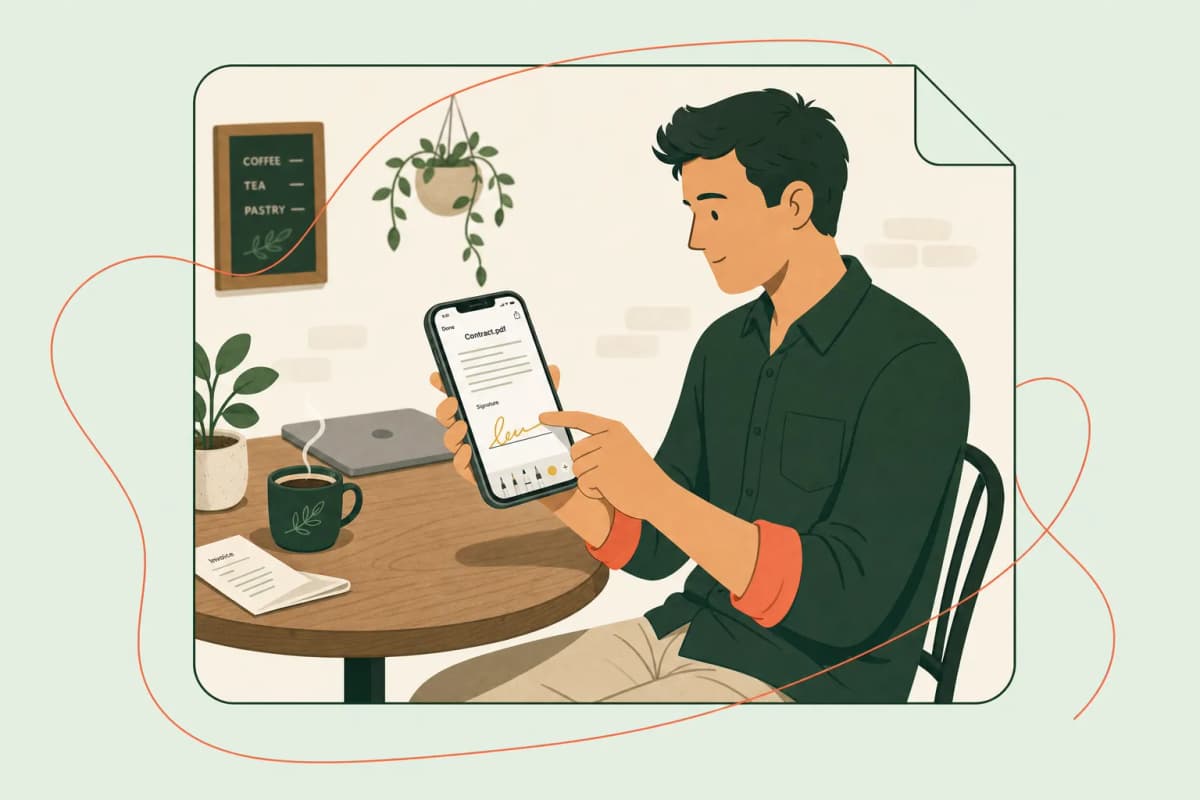
Here's the modern part: you don't need to print, drive across town, and sign in person anymore. Electronic signatures are fully legal for payment agreements in the United States, thanks to the federal E-SIGN Act and the Uniform Electronic Transactions Act adopted by nearly every state. An agreement signed electronically carries the same legal weight as one signed in ink. That means you can draft your payment agreement, send it to the other party, and have it signed and binding within minutes — no printer, no scanner, no "I'll mail it back next week" delays that let momentum die. This is exactly where a tool like Dochives shines: you fill in the terms, both parties sign on whatever device they're holding, and everyone walks away with a legally binding copy. The whole "make it official" step shrinks from days to minutes.
Common Mistakes to Avoid When Writing a Payment Agreement
After watching a lot of these agreements succeed and fail, the same handful of mistakes show up again and again. Avoid these and you're already ahead of most people writing their own contracts.
Mistake #1: Being vague about dates and amounts. We've covered this, but it's the number-one killer for a reason. "He'll pay me back when he can" is not a payment term — it's a wish. Every amount and every date must be concrete. If you can't fill in a specific number, you're not ready to sign.
Mistake #2: Skipping the late-fee and default clauses. People avoid these because they feel pessimistic, like planning for a fight at a wedding. But the absence of these clauses is exactly what turns a small problem into a large one. Without defined consequences, a late payment has no teeth and the payer has no incentive to prioritize you.
Mistake #3: Charging illegal interest. Enthusiastic lenders sometimes tack on interest rates that blow past state usury limits without realizing it. The result can be unenforceable interest or, worse, a voided agreement. Always check your state's cap before setting a rate.
Mistake #4: No signatures — or only one. An unsigned agreement, or one signed by only one party, is barely worth the paper. Both sides must sign and date. I've seen people draft a beautiful, thorough agreement and then never actually get it signed because everyone "meant to." Meaning to doesn't hold up in court.
Mistake #5: Relying on text messages and verbal add-ons. You write a clean agreement, then later modify it over text — "hey, let's push this month's payment to the 20th." Now your real agreement is scattered across a document and a dozen messages. Include a clause requiring all amendments to be in writing and signed, and actually follow it. Amend the document itself, not the group chat.
Mistake #6: Forgetting the "entire agreement" clause. Without it, the other party can later claim there were additional verbal promises ("you said you'd waive the last payment"). An entire-agreement clause states that the written document is the complete and final deal, shutting down those after-the-fact claims.
Mistake #7: Using terms you don't understand. People copy intimidating legal language from somewhere online and paste it in without knowing what it means. If a clause is in your agreement, you should be able to explain it in plain English. When in doubt, simpler is safer — and for any large or complicated deal, a quick consult with a licensed attorney or a resource like Nolo is money well spent.
The common thread through all of these? Cutting corners to avoid a slightly awkward conversation today, which guarantees a much worse conversation later. A thorough payment agreement is uncomfortable for about ten minutes and comfortable for the entire life of the deal.
Payment Agreement Templates and Examples to Start From
You don't have to write a payment agreement from a blank page — and honestly, you shouldn't. Starting from a solid template means the structure and the essential clauses are already there; you just customize the details to your situation. It's faster, and far less likely to leave out something important.
So what should you look for in a good template? A complete payment agreement template should include slots for every element we covered: the parties, the total amount, the payment schedule, the method, interest and late fees, default terms, governing law, and signature blocks. If a template is missing any of those, treat it as a starting skeleton you'll need to flesh out, not a finished product.
Here's how to think about matching the template to your situation:
- Small, friendly loan? Keep it lean. A simple payment agreement template covers the must-haves — who, how much, when, and a signature line — without burying a $500 loan between friends under pages of clauses it doesn't need.
- Structured payoff over time? Reach for something built for installments. The free payment plan contract template includes a payment schedule, interest handling, and acceleration clauses designed for balances paid in chunks.
- Not sure which fits? Browse a full set. Our collection of free payment agreement templates covers installment plans, lump-sum deals, promissory notes, past-due invoices, and personal loans, so you can grab whichever format matches your deal.
Once you've picked a template, customize it honestly. Don't leave placeholder text or "[insert amount here]" lingering in the final version — those leftovers are exactly the kind of thing that makes an agreement look sloppy and unenforceable. Replace every bracket with real details. Delete clauses that don't apply. Add any specific to your deal, like a collateral description for a secured loan or a confidentiality line for a business arrangement.
Let me give you a quick example of customization in action. Say you're using a general template for a personal loan to your brother for $4,000, repaid over a year at a low interest rate. You'd fill in both your full names, set the principal at $4,000, build a 12-month schedule of roughly $340 per month, add a modest interest rate (staying under your state's cap and above the IRS minimum), include a 5-day grace period with a small late fee, and define default as two consecutive missed payments. Both of you sign electronically. Ten minutes of work, and a $4,000 loan that could have strained a sibling relationship is now a clear, fair, documented deal that practically runs itself.
The template gives you the bones. Your specifics give it life. Together, they produce an agreement that protects both sides and reads like it was written by someone who knew exactly what they were doing — because, after reading this guide, you do.
Conclusion
Writing a payment agreement comes down to answering four questions clearly — who, how much, when, and what if — and then getting both signatures on the page. We walked through what a payment agreement is and when you need one, why putting it in writing protects both sides, the essential elements every agreement must include, and a step-by-step process for building one from scratch. We covered how to write clear payment terms, structure an installment schedule, handle the uncomfortable-but-essential late-fee and default clauses, and make the whole thing legally binding — including the fact that electronic signatures carry full legal weight. And we flagged the common mistakes that quietly sink homemade agreements so you can sidestep every one.
The big takeaway is simple: a written payment agreement isn't about distrust, it's about clarity. Clarity prevents disputes, preserves relationships, and gives both parties a clean record they can rely on. The ten awkward minutes it takes to write one will save you weeks of stress, and possibly thousands of dollars, down the road.
Want to go deeper? Browse more guides, templates, and how-tos on the Dochives blog — from payment plans to e-signature law, there's plenty more to help you handle documents the smart way.
Ready to turn your payment agreement into a signed, legally binding document in minutes? Try Dochives free — fill in your terms, send it off, and get every signature without a single printer in sight.