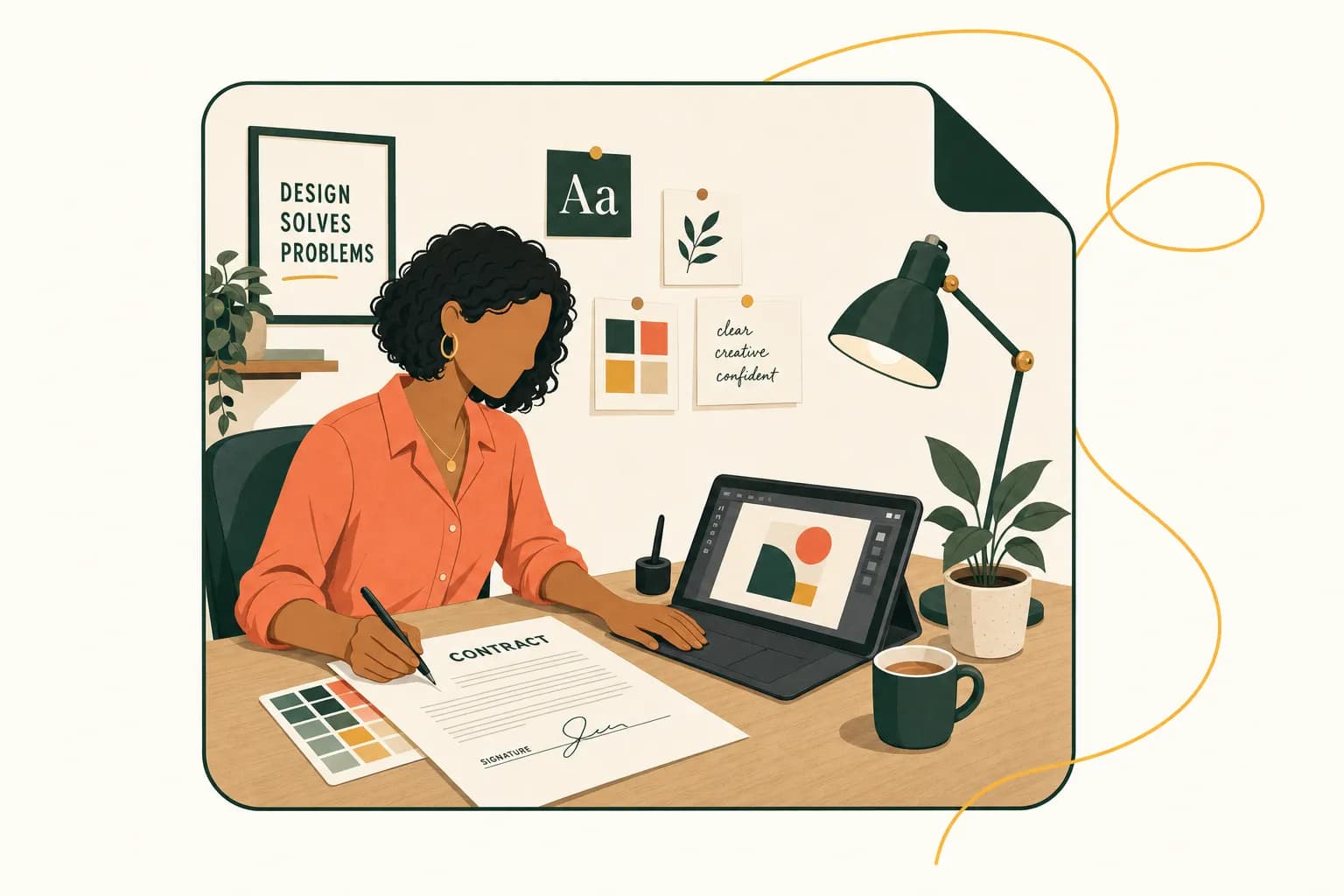
Why Every Graphic Designer Needs a Written Contract
If you're a graphic designer working without a signed contract, you're essentially running your business on a handshake and a hope. A written contract protects you by clearly spelling out project scope, payment terms, revision limits, and ownership rights — so when disputes arise (and they will), you have something concrete to point to instead of relying on a client's memory of what was "agreed" over email three months ago.
I've talked to enough freelance designers to know how this story usually goes. You land a client, you're excited, the work sounds simple enough, and you just... start designing. No contract, just a few back-and-forth emails and a verbal promise about payment. Then the client asks for a fourth round of revisions you never agreed to, or worse, disappears when the invoice comes due. Sound familiar? It happens to nearly everyone at least once, and it's almost always preventable.
Here's the thing: a contract isn't about distrust. It's about clarity. Think of it like a map for a road trip — you could wing it and hope you end up in the right place, but a map (or a contract) makes sure everyone's heading the same direction from the start. Without one, you're exposed to real risks: scope creep, late or missing payments, disputes over who owns the final artwork, and even legal claims if a client says you promised something you didn't. The Small Business Administration notes that clear written agreements are one of the simplest ways small businesses can protect themselves from costly misunderstandings — and design work is no exception.
A solid contract also protects your client, which matters more than it might seem. Clients want to know what they're paying for, when they'll get it, and what happens if things change mid-project. When you hand over a professional agreement upfront, it signals that you run a legitimate business — not a side hustle held together by good intentions. That kind of professionalism often becomes a competitive advantage in itself.
For a contract to actually hold up, though, it needs the right components. If you're unsure what those are, it's worth reviewing what are the elements of a valid contract before you draft anything — offer, acceptance, consideration, and mutual intent all need to be present for an agreement to be enforceable under contract law, as explained by resources like Cornell Law School's Legal Information Institute.
If graphic design isn't the only service you offer, it's also worth looking at free professional services contract templates to cover consulting, branding strategy, or other adjacent work. And if client confidentiality is a concern — say, you're designing for an unreleased product — a Free NDA Template: Non-Disclosure Agreement Guide is worth having in your back pocket too, alongside something like a Free Website Design Contract Template if your work overlaps into web design.
Bottom line: a contract isn't paperwork for paperwork's sake. It's the foundation that lets you focus on the creative work instead of worrying about what happens if things go sideways.
Free Graphic Design Services Agreement Template
Download this free template and customize it for your needs.
Contract vs. Agreement vs. Statement of Work: What's the Difference?
Here's the short answer: a contract and an agreement are basically the same thing legally, while a statement of work (SOW) is a separate document that lives inside a contract to spell out the specifics of a particular project. If you've ever felt confused scrolling through graphic design contract examples online and seeing these terms used interchangeably, you're not imagining things. The confusion is common, and it trips up even experienced freelancers.
Let's untangle it.
Contract vs. agreement — this one's easy. In everyday freelance use, these words mean the same thing: a legally binding promise between two or more parties. The Uniform Commercial Code, which governs contracts in the U.S., doesn't draw a meaningful distinction between them either. So if you're searching for a graphic design agreement sample versus a contract template, don't stress over which word is "more correct." They're interchangeable in casual and even most legal contexts. What actually matters is what's inside the document — the terms, the obligations, the protections.
Where things get more interesting is the statement of work. Think of your contract as the marriage — it covers the big-picture stuff: payment terms, ownership of intellectual property, confidentiality, what happens if someone breaks the deal. The SOW, on the other hand, is more like the honeymoon itinerary. It's specific to one project or phase, and it answers the nuts-and-bolts questions: What exactly are you designing? How many revisions are included? What's the deadline? What file formats will you deliver?
Here's why this distinction matters for graphic designers specifically. Say you land a retainer client who hires you for ongoing brand work throughout the year. You don't want to draft a brand-new contract every time they need a new logo variation or social media template. Instead, you sign one master contract that covers the relationship's ground rules, then attach a fresh SOW for each new project. This keeps your paperwork lean and your client relationship flexible, without sacrificing legal protection.
Freelance platforms and small business resources, including guidance from the U.S. Small Business Administration, often recommend this layered approach because it scales well as your business grows. A single designer doing one-off logo projects might not need an SOW at all — a solid contract covers it. But a design studio juggling multiple deliverables per client? That's where SOWs earn their keep.
One more term you might encounter: the letter of agreement, which is essentially a simplified contract, often used for smaller or short-term gigs. It's less formal in tone but still legally binding if it includes the essential elements — offer, acceptance, and consideration, as outlined in standard contract law principles taught in most business law courses.
Bottom line? Don't get hung up on labels. Get hung up on substance — because a beautifully named document with vague terms won't protect you nearly as well as a clearly written one, whatever you call it.
Key Clauses Every Graphic Design Contract Should Include
If you've ever stared at a blank contract template wondering what actually needs to be in there, you're not alone. Most graphic design contract examples circulating online look intimidating because they try to cover every possible scenario. In reality, a solid graphic design agreement sample boils down to five essential clauses. Get these right, and you've covered 90% of the disputes that tend to blow up freelance relationships.
Scope of work. This is the backbone of your contract, and it's where vague language causes the most trouble. Don't just write "logo design" — spell out exactly what you're delivering: how many initial concepts, what file formats, whether it includes brand guidelines or just the mark itself. Think of scope of work like the guardrails on a highway. Without them, projects drift into "well, can you also just quickly..." territory, and suddenly you're doing three times the work for the original fee.
Deliverables. Closely tied to scope, but worth calling out separately. List the specific files and formats the client will receive — vector files, PNGs, print-ready PDFs, source files — and note what they won't get unless they pay extra (like editable layered files). This clarity protects you from the classic "I thought I was getting the Illustrator file" conversation.
Revisions policy. Every designer has a horror story about a client who wanted "just one more tweak" for the tenth time. Set a specific number of revision rounds included in the price, define what counts as a "round," and state your rate for anything beyond that. This single clause has probably saved more designer-client relationships than any other.
Payment terms and deposit. According to guidance from the U.S. Small Business Administration, clear payment expectations reduce cash flow surprises for small businesses — and that applies just as much to freelancers as it does to companies with employees. Spell out your total fee, payment schedule (upfront deposit, milestone payments, final balance), accepted payment methods, and late fee policy. A deposit of 25-50% before work begins is standard practice among freelance designers and protects you from investing hours into a project that stalls or disappears.
Timeline and milestones. Vague deadlines create vague expectations. Break the project into milestones — concept delivery, revision rounds, final files — with dates attached to each. This also gives you leverage: if the client is late approving a milestone, your delivery date shifts accordingly, and your contract should say so explicitly.
One more thing worth mentioning: intellectual property and usage rights deserve their own clause too, since copyright ownership of design work doesn't automatically transfer to the client just because they paid for it — a point the U.S. Copyright Office addresses directly in its guidance on ownership.
Want a head start instead of building all this from scratch? Try Dochives free and get a professional contract signed faster.
Ownership and Usage Rights: Copyright Transfer vs. License
Here's a question that trips up more designers than it should: when a client pays you for a logo, do they own it — or just the right to use it? The answer isn't automatic, and if your contract doesn't spell it out, you're leaving it to chance (or worse, to a judge).
Under U.S. copyright law, the person who creates a work is generally the copyright owner from the moment it's fixed in a tangible form — even if someone else paid for it. That surprises a lot of clients who assume payment equals ownership. According to the U.S. Copyright Office, ownership only transfers automatically in narrow "work made for hire" situations, and freelance graphic design typically doesn't qualify unless there's a signed agreement stating otherwise. This is exactly why your contract needs to address ownership explicitly, in plain language, rather than assuming everyone's on the same page.
There are really two paths here, and you need to pick one deliberately for every project.
Copyright transfer (assignment). This means you're handing over full ownership of the final artwork once the client pays in full. They can modify it, resell it, use it however they want, forever. This is common for logo design and branding work, where clients reasonably expect to own their visual identity outright. If you go this route, make sure the transfer language is tied to payment in full — not to project completion. I've seen designers get burned by handing over files before the final invoice clears.
Licensing. Instead of transferring ownership, you grant the client a license to use the work for specific purposes — maybe a website, print materials, or social media — while you retain the underlying copyright. Licensing is common in illustration work, stock-style graphics, or ongoing brand campaigns where you might reuse design elements across multiple clients. A license can be exclusive or non-exclusive, time-limited or perpetual, and you get to define all of that in the contract.
Neither approach is inherently better — it depends on your business model and what the client actually needs. What matters is that you name it clearly in the agreement instead of leaving "ownership" as an assumed default.
Don't forget the portfolio clause, either. Most designers want the right to display their work publicly, even after transferring copyright, because a portfolio is basically your résumé. Spell out that you retain the right to showcase the project in your portfolio, case studies, and marketing materials — unless the client has a legitimate confidentiality reason to restrict it, which sometimes happens with unreleased products or sensitive branding.
Getting this section right protects both sides from confusion down the road. If you want a contract that already includes clean, editable ownership and licensing language, try Dochives free and see how much faster professional document signing can be.
Kill Fees, Cancellation, and Termination Clauses
Here's a scenario every freelance designer knows too well: you've cleared your calendar, turned down other work, and spent three days sketching logo concepts—then the client emails to say the project's "on pause indefinitely." No explanation, no kill fee, nothing. Without a cancellation clause in your contract, you have almost no recourse. That's why kill fees, cancellation terms, and termination clauses aren't optional extras—they're how you protect your time and income when a project falls apart mid-way.
What is a kill fee, exactly? A kill fee is a predetermined payment a client owes you if they cancel a project after work has begun but before it's finished. Think of it as compensation for the time you've already invested and the other work you turned away to take this project. It's standard practice in publishing and design industries, and building one into your graphic design agreement sample protects you from doing real work for zero pay.
A common structure looks like this: if the client cancels before you start, they owe nothing beyond any deposit already paid. If they cancel after concepts are delivered but before revisions, they owe 50% of the total fee. If they cancel after final files are nearly complete, they owe 75-100%. You can adjust these percentages based on your workflow, but the principle stays the same—the further along you are, the more you've earned.
Cancellation clauses need specifics, not vague language Don't just write "client may cancel at any time." Spell out how cancellation must happen (written notice, ideally via email so there's a timestamp), how many days' notice is required, and what happens to work-in-progress. Does the client get partial files? Do you retain ownership until final payment clears? These details matter, and leaving them out invites disputes.
Termination for cause vs. termination for convenience It helps to separate these two scenarios in your contract. Termination for convenience means the client simply changes their mind—no wrongdoing on either side. Termination for cause means someone breached the agreement, like a client who's gone silent for 60 days or hasn't paid an invoice. Your remedies should differ: convenience-based termination typically triggers the kill fee schedule, while cause-based termination might let you invoice immediately for all work completed to date, per contract fundamentals outlined in resources like the Small Business Administration's guide to contracts.
Your right to terminate, too Don't forget this clause should protect you as much as the client. If they're unresponsive, abusive, or asking you to violate ethical standards (say, plagiarizing another designer's work), you need language allowing you to walk away and still collect payment for work completed.
Once you've nailed down these terms, using consistent, well-structured graphic design contract examples for every client saves you from renegotiating boilerplate language each time. Try Dochives free and see how much faster professional document signing can be: https://dochives.com
Payment Schedules, Deposits, and Late Payment Penalties
Let's talk about the part of freelancing that nobody loves discussing but everyone loves getting paid for: money mechanics. I've seen too many talented designers do gorgeous work and then chase invoices for months like it's a part-time job. It doesn't have to be that way. A well-structured payment schedule, baked right into your contract, protects your cash flow and sets expectations before a single pixel gets designed.
Why Milestone Payments Beat "Pay Me When You're Done"
Waiting until a project wraps to invoice the full amount is risky. Scope creeps, clients disappear, priorities shift on their end — and suddenly you're owed thousands of dollars for work you can't take back. Milestone payments break the project into chunks tied to deliverables, so you're never too far out on a limb.
A typical structure for a mid-sized branding or design project might look like this:
- Deposit (30–50%) due before you start any work
- Midpoint payment (25–35%) due after concept approval or first draft delivery
- Final payment (remaining balance) due upon final file delivery, before releasing high-res or source files
For smaller projects, a simple 50/50 split — half up front, half on completion — works fine. For bigger, multi-month engagements, consider monthly billing instead of milestone billing, especially if the scope is more ongoing than deliverable-based.
The key is writing the exact percentages, dollar amounts, and trigger events directly into the contract. Vague language like "payment due at reasonable intervals" invites disputes. Specificity is your friend here.
Deposits: Your Skin-in-the-Game Insurance
A deposit isn't just about cash flow — it filters out clients who aren't serious. Anyone unwilling to put money down before you start is telling you something. Most designers ask for 25–50% upfront, and it's worth stating clearly in your contract that the deposit is non-refundable once work begins, unless you cancel the project yourself.
The U.S. Small Business Administration has solid guidance on structuring invoicing practices for small businesses, and it echoes what most freelancers learn the hard way: get paid incrementally, not all at once at the end.
Enforcing Late Payment Penalties
Here's where a lot of contracts go soft. You can write "payment due within 15 days" all day long, but without a consequence attached, that deadline is just a suggestion. Add a late fee clause specifying either a flat fee (say, $50 after 10 days late) or a percentage-based interest charge (commonly 1.5–2% per month) on the outstanding balance.
Check your state's usury laws before setting an interest rate — some states cap what you can legally charge on unpaid invoices, so it's worth a quick look at your state's consumer protection office or a consult with a local attorney if you're unsure.
Beyond fees, give yourself leverage: state explicitly that work stops and files aren't released until payment clears. It sounds harsh, but it's standard practice, and clients respect a designer who values their own time.
Once you've got your payment terms nailed down, getting the contract signed shouldn't be the bottleneck. Try Dochives free and see how much faster professional document signing can be — you can have milestone-based agreements out the door and signed before your coffee gets cold: https://dochives.com.
Confidentiality, Liability, and Independent Contractor Status
This is the part of your contract that quietly protects you when things get messy — and in freelance graphic design, things eventually get messy. A client shares unreleased branding, a project goes sideways, or someone tries to treat you like a full-time employee without the benefits. Let's break down what actually belongs here.
NDA basics: keeping client secrets safe
If you're designing packaging for an unreleased product or building a rebrand before a public announcement, your client is trusting you with sensitive information. A confidentiality clause — sometimes a full standalone NDA (non-disclosure agreement) — spells out that you won't share logos, mockups, business strategy, or product details before launch. Most graphic design contract examples include a basic mutual confidentiality clause rather than a lengthy standalone NDA, since freelance projects rarely need the heavier legal weight of enterprise-level agreements. Still, the core elements matter: define what counts as confidential, how long the obligation lasts (often 1–3 years post-project), and what's exempt, like publicly available information. The U.S. Small Business Administration has helpful general guidance on protecting business information if you want a primer before drafting your own language.
Liability limitations: capping your exposure
No designer wants to be on the hook for a client's lost revenue because a print run got delayed. A limitation of liability clause caps how much you could owe if something goes wrong — typically limiting damages to the amount the client actually paid you. This isn't about dodging responsibility; it's about making sure a $2,000 logo project can't somehow turn into a $200,000 lawsuit. Any solid graphic design agreement sample you find online will include this clause, and for good reason — it's one of the most important protections a freelancer can have.
Indemnification: who covers what
Indemnification clauses determine who pays if a third party sues over the work. Say a client insists on using a stock photo you flagged as risky, and it turns out to be copyrighted. A well-written indemnification clause protects you if the client ignored your warning, while also protecting the client if your original design turns out to infringe on someone else's intellectual property. The U.S. Copyright Office's overview of copyright basics is worth a read if you want to understand why this clause matters so much in creative work.
Independent contractor status: protecting your freedom
Finally, your contract should explicitly state that you're an independent contractor, not an employee. This affects taxes, benefits, and legal classification — and misclassification can create real headaches for both parties. The IRS provides a clear breakdown of independent contractor versus employee status, which is a useful reference when drafting this language. Including a simple line confirming you control your own hours, tools, and work methods goes a long way toward keeping that distinction airtight.
Want contract language that already includes all of this? Try Dochives free and see how much faster professional document signing can be.
Free Graphic Design Contract Template: What's Inside
So you've read through all the clauses and legal reasoning — now let's actually open the thing up. Our free graphic design contract template isn't a generic legal form pulled from some dusty filing cabinet. It's built specifically around how design work actually happens: the back-and-forth revisions, the file handoffs, the client who wants "just one more logo option." Here's a section-by-section walkthrough of what's inside and how to make it your own.
1. Parties and Project Overview The top of the document identifies you (or your studio) and your client, along with a plain-English description of the project. This is where you'll swap in specifics — "design of a primary logo and brand mark" versus "development of five web banner graphics for a Shopify homepage." Vague descriptions here cause more disputes than almost anything else, so be as concrete as you can.
2. Scope of Work This section lists deliverables, file formats, and number of revision rounds. If you're doing branding work, you'll want to itemize things like logo variations, color palette, typography guide, and brand style sheet. For web graphics, swap that out for asset dimensions, platforms (Instagram, web banners, email headers), and export formats like SVG or WebP. Customizing this section well is the single biggest factor in avoiding scope creep — the Graphic Artists Guild has solid pricing and scope guidance worth cross-referencing if you're unsure what's standard.
3. Timeline and Milestones A fillable table lets you map out kickoff dates, draft delivery, feedback windows, and final handoff. Logo projects tend to be shorter and more linear; branding packages often need milestone-based delivery (concept, refinement, final files) since there's more back-and-forth.
4. Fees and Payment Terms This links back to the payment structure clauses covered earlier — deposit percentage, remaining balance, and due dates are all placeholder fields you fill in.
5. Ownership, Licensing, and File Delivery This is the section you'll edit most heavily depending on project type. Logo and branding work typically transfers full copyright upon final payment, per the U.S. Copyright Office's guidance on transfers of ownership, while web graphics might stay licensed rather than fully assigned if you're reusing templates or stock elements.
6. Signature Block The final page includes signature lines for both parties, with space for dates. If you're using Dochives to send the contract, this section auto-populates into a legally binding e-signature field, so there's no printing, scanning, or chasing down a fax machine.
Once you've customized these sections for your specific project type, you're not starting from scratch every time — you're just adjusting a handful of fields. That's the whole point of a template: less drafting, more designing.
Speeding Up Contract Signing with E-Signatures
Let's be honest: nobody becomes a graphic designer because they love paperwork. You want to be sketching logo concepts or building out a brand style guide, not chasing a client for a wet-ink signature on a PDF they printed, signed, and then forgot to scan back to you. This is exactly where e-signatures earn their keep.
E-signatures let you send a contract, get it signed, and countersign it yourself in the time it used to take just to find a working printer. The U.S. federal ESIGN Act, passed back in 2000, gives electronic signatures the same legal weight as handwritten ones for most business contracts, so you're not sacrificing enforceability for speed. If you want the specifics on what qualifies, the Federal Trade Commission's guidance on the ESIGN Act is a good place to start.
Here's the real-world version of how this plays out. Say you're wrapping up a discovery call with a new client for a packaging design project. In the old workflow, you'd draft the contract, email it as a PDF, wait for them to print it, sign it, scan it, and email it back — assuming they even have a scanner handy anymore. Days can pass. Momentum dies. With e-signature tools like Dochives, you send the contract right after the call, the client signs from their phone or laptop within minutes, and you countersign on the spot. The project can kick off the same day instead of the same week.
Speed isn't the only benefit, though. E-signature platforms typically log timestamps, IP addresses, and an audit trail for every signature — which matters if a dispute over deliverables or payment ever comes up later. That kind of documentation can be genuinely useful, especially since freelance contract disputes aren't exactly rare in creative industries, as surveys from organizations like the Freelancers Union have highlighted over the years.
There's also something to be said for how e-signatures reduce the small frictions that quietly kill deals. A client who's excited about your design work today might cool off by next week if signing feels like a hassle. Removing that barrier keeps the energy of "yes, let's do this" intact long enough to actually get pen to paper — or finger to touchscreen, as it were.
For freelancers juggling multiple clients, this efficiency compounds. Instead of manually tracking who's signed and who hasn't, you get notifications, reminders, and a clear record of every executed contract in one place. That's less mental overhead and more time actually designing.
If you're still emailing PDFs back and forth, it might be worth rethinking that workflow. Try Dochives free at dochives.com and see how much faster professional document signing can be — for your contracts, your clients, and your sanity.
People Also Ask
What should be included in a graphic design contract?
At a minimum, you want the scope of work, deliverables, timeline, payment terms, and ownership rights spelled out clearly — vague language is where most disputes start. Think of it like a recipe: if you skip an ingredient, the final dish (or in this case, the working relationship) doesn't turn out right. A solid graphic design agreement sample will also touch on revisions, kill fees, and confidentiality, so nothing gets left to interpretation. If you're piecing one together yourself, the U.S. Small Business Administration's contract guidance is a helpful starting point for understanding what legal basics small businesses should cover.
How do I write a simple graphic design agreement?
Start with the essentials: who's involved, what you're delivering, when it's due, and how much it costs. You don't need dense legal jargon — plain English that both parties actually understand works better and holds up just as well. Many freelancers start from graphic design contract examples or a template and customize the clauses (usage rights, payment schedule, cancellation terms) to fit the specific project. Once it's drafted, sending it for signature electronically speeds things up considerably compared to printing, signing, and scanning.
Do freelance graphic designers need a signed contract?
Yes — even for small or quick projects. Without a signed contract, you have no formal proof of what was agreed on, which makes it much harder to collect payment or resolve disagreements about scope or ownership. A written, signed agreement protects both you and your client, and it signals that you run a professional operation, not a side hustle. If you want to see how much faster professional document signing can be, Try Dochives free at https://dochives.com.