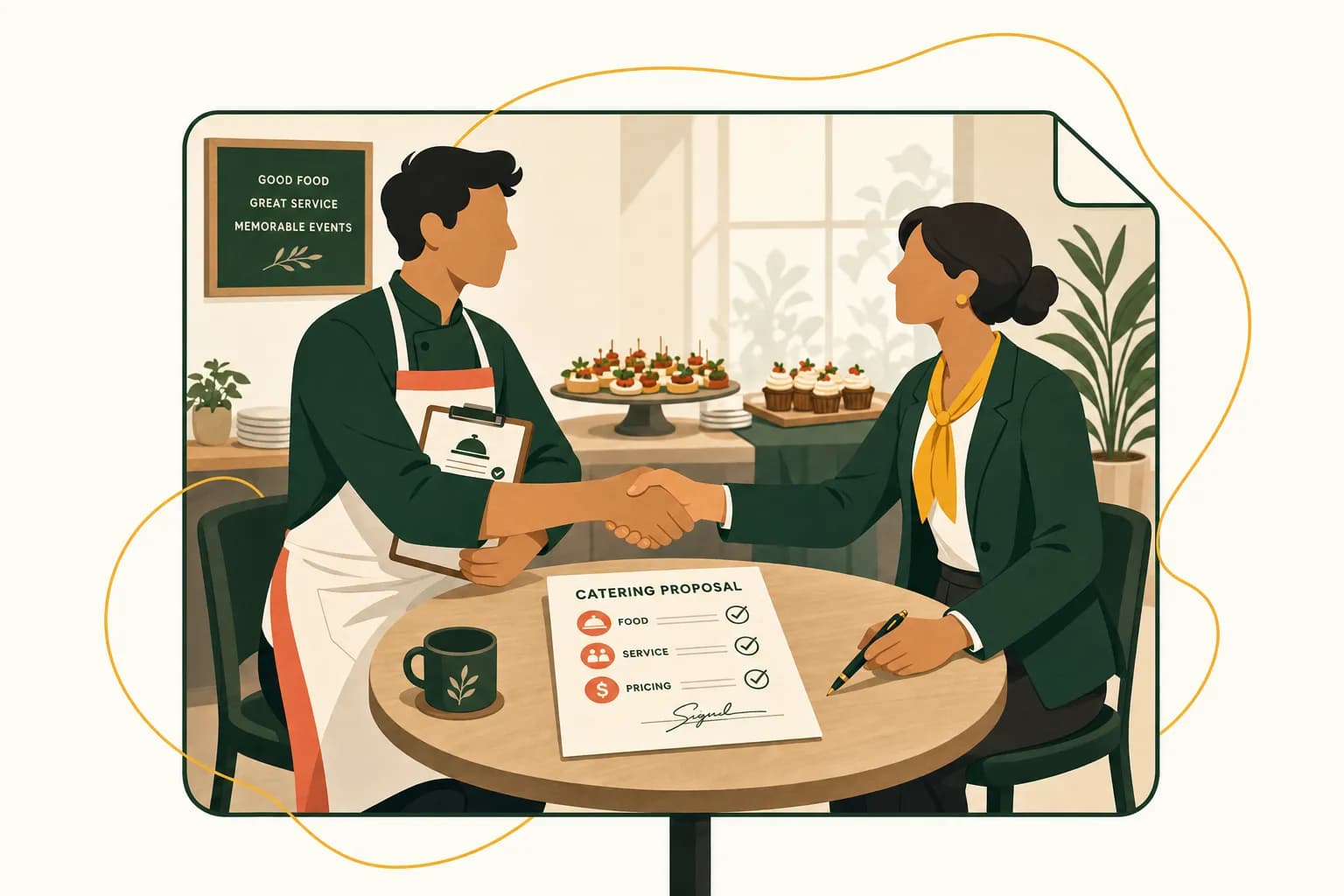
What Is a Catering Contract and Why You Need One
A catering contract is a written agreement between a caterer and a client that spells out exactly what food, service, staffing, and pricing will be delivered for an event — and when. Think of it as the rulebook for your event: it tells everyone what's expected, what happens if plans change, and who's on the hook if something goes wrong. If you've ever searched for a sample contract of agreement for catering services, it's usually because you've had (or heard about) a booking go sideways without one, and you never want to relive that.
I've talked to caterers who ran their first few years on handshake deals and text message confirmations. It worked — until it didn't. A client swore they never agreed to the guest count increase. A bride's mother insisted the quote included bar service when it clearly didn't. Without paper to point to, these disputes turn into he-said-she-said arguments, and honestly, nobody wins those. A solid catering contract example removes the guesswork by putting every detail in black and white before the first plate ever leaves the kitchen.
So why does this matter so much for small catering businesses and independent event pros? Because catering sits at the intersection of food safety, hospitality, and logistics — three areas where small misunderstandings can turn into expensive problems. A well-drafted catering agreement sample typically covers:
- Menu and service details — what's being served, how it's plated or stationed, and any dietary accommodations
- Guest count and pricing — including deadlines for final headcount changes
- Payment terms — deposit amounts, due dates, and cancellation or refund policies
- Event logistics — date, time, venue access, setup and teardown windows
- Liability and insurance — especially important given health and safety guidelines from bodies like the FDA's Food Code, which many local health departments use as a baseline for food service standards
- Force majeure clauses — protecting both parties if weather, illness, or emergencies force a cancellation
For the agreement to actually hold up, it needs to meet the basic legal requirements of any valid contract — offer, acceptance, consideration, and mutual intent, among other things. If you're unfamiliar with these fundamentals, our post on what are the elements of a valid contract breaks it down in plain language.
Catering contracts aren't unique in this respect — they share a lot of DNA with other event service agreements. If you're planning a larger event with multiple vendors, you might also want to look at a free event planner contract template or a free event management contract template to keep every vendor relationship equally protected. And if catering is just one piece of a bigger event puzzle that includes entertainment, a free wedding DJ contract template can round out your vendor paperwork.
A good catering proposal template, paired with a contract, does double duty: it wins the client's trust upfront and protects you legally once they've signed. That's the real value here — not just paperwork for paperwork's sake, but a tool that lets you run your catering business with confidence instead of crossed fingers.
Free Catering Contract Template
Download this free template and customize it for your needs.
Catering Contract vs. Catering Proposal Template: What's the Difference
If you've been searching for a "catering proposal template" and a "catering contract example" and wondering if they're the same thing, I get the confusion. They're cousins, not twins. Mixing them up can cost you time, money, or an awkward conversation with a client who thought they'd already agreed to something binding.
Think of it this way: a catering proposal is the pitch, and a catering contract is the handshake that seals the deal.
The proposal comes first.
A catering proposal template is essentially a sales document. It's what you send a prospective client after an initial inquiry or tasting to show them what you're offering, what it'll cost, and why you're the right caterer for their event. It usually includes:
- A breakdown of menu options and pricing tiers
- Service style (buffet, plated, family-style, drop-off)
- Estimated headcount and per-person cost
- Optional add-ons like bar service, rentals, or staffing
- Your business's branding, photos, or testimonials
There's nothing legally binding here. It's persuasive, not contractual. You're trying to win the business, not lock in the terms yet. Many caterers treat the proposal almost like a menu-meets-invoice hybrid — something that helps the client visualize the event and compare you against competitors.
The contract comes after they say yes.
Once the client approves the proposal, that's your cue to move to a signed catering agreement sample or a formal catering contract template in Word or PDF. This is where things get legally real. A solid catering contract example will spell out:
- Final guest count and deadline for changes
- Payment schedule, deposits, and cancellation terms
- Liability and insurance details (the National Restaurant Association offers general guidance on food service liability considerations)
- Setup, service, and cleanup responsibilities
- What happens if the event is postponed or canceled
Unlike the proposal, this document is meant to hold up if there's ever a dispute. The U.S. Small Business Administration recommends having clear written agreements for any client-facing service business — catering included — precisely because verbal agreements or casual quotes don't protect you if a client backs out last minute or disputes a charge.
Why the distinction matters for your business
Here's the practical difference: a proposal is flexible and can be revised multiple times as you negotiate menu and pricing. A contract, once signed, is fixed unless both parties agree to an amendment. If you accidentally send a contract when you meant to send a proposal, you might find yourself locked into terms before pricing is finalized — not a great spot to be in.
I've seen small catering businesses lose money simply because they skipped the proposal stage and jumped straight to a contract, locking in a headcount that changed two weeks later with no clause to account for it.
Using both documents — proposal first, contract second — keeps your process clean and professional. And if you want to skip the manual back-and-forth of collecting signatures, try Dochives free and see how much faster professional document signing can be: https://dochives.com
Key Elements of a Catering Contract
Every solid catering contract example, no matter the caterer or the event, tends to circle back to the same handful of building blocks. Skip one of these, and you're basically leaving a door open for a misunderstanding to walk right through. Let's go through what actually needs to be in there.
The Parties Involved
This sounds obvious, but you'd be surprised how many contracts get sloppy here. You need full legal names — the catering business and the client — plus contact information and, if applicable, the name of the venue if it's a separate entity. If you're catering a corporate event, list the company name and the specific point of contact who has authority to approve changes. This matters more than people think; under basic contract law principles, an agreement needs identifiable parties who have the legal capacity to enter into it. Vague or missing names can create headaches if a dispute ever comes up.
Event Date, Time, and Location
Your contract should nail down the exact date, start and end times, setup and breakdown windows, and the full address of the venue. I'd also throw in a line about what happens if the event runs long — does overtime cost extra? Most catering agreement samples include this because event timelines shift constantly, and you don't want a five-hour reception turning into an eight-hour one for free.
The Menu
This is where a lot of the back-and-forth with clients happens, so get specific. List every course, dish, and beverage option, along with any substitutions for dietary restrictions. If you're offering tastings beforehand, note the date and whether it's included in the price. A catering proposal template usually sketches this out loosely to win the business; the actual contract needs to lock it in with precision, including headcount and per-person serving sizes.
Pricing and Fees
Break down the total cost line by line: food, staff, rentals, service charges, gratuity, and taxes. Ambiguity here is where most catering disputes start. If you're using a catering contract template word document, make sure the pricing table is easy to edit as guest counts or menu choices change, since these numbers rarely stay static until the final headcount deadline.
Payment Schedule
Nearly every sample contract of agreement for catering services includes a deposit (often 25–50%) due at signing, with the balance due before or on the event date. Spell out accepted payment methods, due dates, and late fees. This protects your cash flow and sets clear expectations for the client.
Cancellation and Liability Terms
Finally, address what happens if the event gets canceled or postponed, and who's liable for damages, illness, or accidents — insurance requirements included, since food handling carries real liability under most state health codes.
Once you've got these sections covered, you're not just filling out a template — you're protecting your business. Try Dochives free at https://dochives.com and see how much faster professional document signing can be.
Deposit, Cancellation, and Refund Policy Clauses
If there's one part of your catering contract that will save your business financially, it's this one. I've said it before and I'll say it again: food, labor, and your time are all sunk costs the moment you start planning an event. When a client cancels three days before their wedding reception, you can't un-order the shrimp or un-book your staff. That's why deposit and cancellation clauses aren't just legal boilerplate — they're your financial safety net.
Start with a non-refundable deposit. Most caterers ask for 25% to 50% of the total estimated cost upfront, due at signing. This does two things: it confirms the client is serious, and it gives you working capital to start purchasing and scheduling. Be explicit in your catering contract template about the amount, the due date, and the fact that it's non-refundable except in specific circumstances (say, if you cancel on them). Vague language here is where disputes start.
Build a tiered cancellation schedule. A flat "no refunds" policy might scare off clients, and a fully refundable policy leaves you exposed. The middle ground — and what most successful catering businesses use — is a sliding scale tied to how close the cancellation is to the event date. For example:
- Cancellations 30+ days out: deposit forfeited, remaining balance refunded
- Cancellations 14–29 days out: 50% of total contract value due
- Cancellations under 14 days: full contract value due
These numbers aren't set in stone — adjust them based on your lead times for ordering perishables and securing staff. A small business booking backyard barbecues might need less runway than a full-service caterer handling 300-person weddings.
Address the "what if I cancel" scenario too. Clients want to know they're protected if something happens on your end — illness, a scheduling conflict, a supplier falling through. Spell out what happens: a full refund, a referral to another vetted caterer, or a rescheduled date at no penalty. This reciprocity builds trust and, frankly, it's just fair.
Don't forget partial cancellations. What if the guest count drops from 150 to 90 two weeks before the event? Your catering agreement sample should specify a deadline for final headcount changes — typically 7 to 10 days before the event — after which the client is billed for the original count, not the reduced one. The U.S. Small Business Administration offers general guidance on protecting cash flow in service-based businesses, and this clause is a direct application of that principle.
Cover force majeure separately. Weather emergencies, venue closures, and other events outside anyone's control (a topic that got a lot of attention after COVID-19 disrupted the events industry, as reported by the National Restaurant Association) deserve their own clause rather than getting lumped into standard cancellations.
Finally, state your refund method and timeline — check, bank transfer, days to process — so nobody's left wondering. Clear terms here prevent the awkward follow-up emails and protect the relationship, even when plans fall through.
Liability, Insurance, and Food Safety Provisions
If there's one section of your catering contract you shouldn't skim, it's this one. I've seen freelance chefs and small catering outfits get burned—sometimes literally, sometimes financially—because they treated liability and insurance clauses as boilerplate. They're not. This is the part of your catering agreement that decides who pays when a guest gets sick, a venue floor gets stained, or a rental company's chafing dishes go missing.
Let's start with liability coverage. Your contract should clearly state who's responsible for what. Are you liable for damage to the venue caused by your equipment? What about injuries to guests during service—say, someone slips near your buffet line? A well-drafted liability clause limits your exposure to incidents directly caused by your negligence, while pushing responsibility for venue-related hazards (like a broken step or faulty wiring) back onto the property owner. Think of it as drawing a fence around your responsibilities. Without that fence, you're exposed to claims that have nothing to do with your food or your team.
Insurance requirements go hand-in-hand with liability language. Most reputable venues will require caterers to carry general liability insurance, and many ask for a certificate of insurance (COI) naming the venue as an additional insured before they'll even confirm your booking date. Coverage amounts vary, but $1 million per occurrence is a common baseline in the industry. If you're using vehicles to transport food, commercial auto insurance matters too. The Insurance Information Institute has solid consumer-facing resources if you want to understand how general liability and business owner's policies differ before you shop for coverage.
Then there's food safety compliance—arguably the most important provision for protecting both your clients and your business. Your contract should reference adherence to local health department regulations and, where applicable, the FDA Food Code, which many states use as the foundation for their own food safety rules. Spell out how food will be stored, transported, and held at safe temperatures, and note that your staff follows safe food handling practices, ideally backed by certifications like ServSafe. If you're catering an outdoor event in July, temperature control clauses aren't just good practice—they're the difference between a great review and a foodborne illness lawsuit.
I'd also recommend including an indemnification clause, which protects you if a client's negligence (not yours) causes harm—say, they insist on serving food past the safe holding time despite your warning. And don't forget allergen disclosure language; requiring clients to inform you of dietary restrictions in writing protects everyone involved.
Building all of this from scratch is tedious, which is exactly why a solid template helps. Try Dochives free and see how much faster professional document signing can be—especially when your contracts already include the liability, insurance, and food safety language catering businesses actually need. Get started with Dochives.
Guest Count Changes, Final Headcount, and Payment Terms
Here's a scenario that plays out at catering businesses every single week: a bride books you for 150 guests in March, then calls in June to say her aunt's whole side of the family is coming after all, so now it's 175. Or the opposite happens — a corporate client books lunch for 80 employees, then half of them decide to work remotely that day, and suddenly you're prepping for a crowd that doesn't exist. If your catering contract doesn't spell out exactly how these changes get handled, you're the one left holding the bag, either scrambling for extra food or eating the cost of ingredients nobody touches.
This is why every solid catering contract template needs a guest count clause that does real work, not just a vague mention of "approximate numbers."
Setting a Final Headcount Deadline
Most experienced caterers require a final guaranteed headcount somewhere between 5 and 10 business days before the event. This isn't arbitrary — it's the window you need to order perishables, schedule staff, and prep without wasting money or scrambling last minute. Your contract should state, in plain language, something like: "Client must provide final guest count no later than [X] days prior to the event date. This number will be considered guaranteed and will be the minimum number billed, regardless of actual attendance."
That last part matters. If you don't lock in a minimum billing number, a client could tell you 175 guests and then only 140 show up, and you'd have no contractual ground to bill for the food and labor you already committed to. The National Restaurant Association and various small business catering guides consistently point to this guaranteed minimum as standard industry practice.
Handling Increases and Decreases
Your catering contract template should also address what happens on both sides of that deadline:
- Before the deadline: Guest count changes (up or down) are typically accepted without penalty, though big swings might require a revised quote.
- After the deadline: Increases may still be accommodated if your kitchen can handle it, often at a rush surcharge. Decreases, though? You'll still bill for the guaranteed number.
Spell this out in your catering agreement sample language so there's zero ambiguity. Ambiguity is where disputes live.
Payment Terms That Actually Protect You
A catering contract example without clear payment terms is really just a hopeful email. You need to specify:
- Total contract price and what it includes
- Deposit amount and due date (covered in your cancellation clause)
- Remaining balance due date — many caterers require full payment 3-5 days before the event
- Accepted payment methods
- What happens if payment is late
Late Fee Clauses
Don't skip this. A late fee clause isn't about nickel-and-diming clients — it's about protecting your cash flow. A typical structure charges a flat fee or a percentage (often 1.5-2%) of the outstanding balance for each week or month payment is overdue. Check your state's usury laws before setting a percentage, since some states cap what you can charge — the Consumer Financial Protection Bureau has resources on lending and fee regulations worth reviewing if you're unsure.
Whether you're using a free catering contract template or building a custom catering proposal template from scratch, these three pieces — headcount deadlines, payment terms, and late fees — are what keep your business financially sound event after event.
Service Details: Staffing, Setup, and Cleanup Responsibilities
Here's where a lot of catering contracts fall apart in real life — not because anyone acted in bad faith, but because nobody wrote down who was supposed to do what. You assumed the venue would handle trash removal. The client assumed your staff would stack chairs. Three hours after the reception ends, you're both standing in a half-cleaned banquet hall arguing about it. A well-built catering contract template word document should make that scenario impossible.
Staffing roles need to be spelled out with actual numbers, not vague promises. How many servers will be on-site? Will there be a bartender, and is that person licensed to serve alcohol in your state? Is a day-of coordinator included, or is that an add-on? I'd recommend listing staff by role and headcount — "3 servers, 1 lead captain, 1 bartender for a 100-guest event" — rather than writing something fuzzy like "adequate staff will be provided." If you're using tipped or hourly staff, it's worth knowing how wage and hour rules apply to your business, since catering crews often work irregular hours and split shifts; the U.S. Department of Labor's wage and hour guidance is a useful reference if you're unsure how overtime or tipped-employee rules affect your staffing costs.
Setup logistics are the next piece, and they trip people up constantly because setup involves more than just your team. Who provides tables, linens, and chairs — you, the venue, or a rental company? What time can your crew access the space? Is there a loading dock, or will staff be carrying chafing dishes up three flights of stairs? Your contract should note the exact setup window (say, "vendor arrival no earlier than 3:00 PM, setup complete by 5:30 PM") and specify who's responsible for equipment like generators, tenting, or electrical hookups if the event is outdoors. If your setup involves open flames, propane, or heavy equipment, it doesn't hurt to reference basic workplace safety standards — OSHA's general industry safety guidelines offer a helpful baseline, even for event-based work.
Cleanup duties are the section people forget until it's 11 PM and everyone's exhausted. Spell out exactly what "cleanup" means in your contract: clearing tables, packing up your own equipment, removing food waste, or full venue restoration? These are very different jobs with very different labor costs. Also address trash and recycling — some venues have strict waste disposal rules, and municipalities increasingly regulate food waste diversion, so it's worth checking local guidance or the EPA's food waste reduction resources if your contract needs to reflect composting or donation practices.
Once you've nailed down these details, don't leave them buried in an email thread. Dochives lets you build this into a clean, signable catering agreement sample your client can approve in minutes — no more chasing signatures or hoping everyone remembers the verbal agreement. Try Dochives free and see how much faster professional document signing can be.
Force Majeure and Weather Contingency Clauses for Outdoor Events
If you've ever catered a wedding under a tent and watched the sky turn green an hour before cocktail hour, you already know why this clause matters. Outdoor events are gorgeous right up until they're not, and a catering contract that doesn't address weather or "acts of God" is a contract that leaves you exposed when things go sideways.
Let's start with the basics: a force majeure clause excuses one or both parties from performing their obligations when something outside anyone's control — a hurricane, wildfire, government shutdown order, or even a pandemic — makes the event impossible or unsafe to hold. Courts generally interpret these clauses narrowly, so vague language like "unforeseen circumstances" won't protect you the way specific, enumerated events will. The Cornell Legal Information Institute has a solid plain-English breakdown of how these clauses function and why specificity matters so much in enforcement.
For outdoor catering specifically, you want to go beyond generic force majeure boilerplate and address weather head-on. Ask yourself: what counts as weather bad enough to trigger the clause? A light drizzle probably doesn't cut it, but a tropical storm warning from the National Weather Service absolutely should. Spell out a threshold — sustained winds above a certain speed, a declared state of emergency, or an official advisory — so you're not arguing about "how bad is bad enough" the morning of the event.
Here's what a solid weather contingency clause typically covers:
- Rain plan trigger point: Who decides to move indoors or under cover, and by what time? Waiting until guests are arriving is too late.
- Backup location responsibility: Is the client responsible for securing a tent or indoor alternative, or is that on you as the caterer?
- Additional cost allocation: Rush tent rentals, generator power, or last-minute staffing changes cost money. Decide upfront who eats that cost.
- Cancellation vs. postponement: Some clients would rather reschedule than cancel outright. Build in a postponement option with a defined rebooking window and whether deposits carry over.
- Notice requirements: Require written notice within a specific timeframe if either party wants to invoke the clause.
I always recommend caterers loop in event insurance here too. Many clients now carry event cancellation insurance specifically for weather risk, and the Insurance Information Institute has helpful guidance on how that coverage typically works and what it does and doesn't include.
One more thing worth mentioning: force majeure clauses aren't just about giant disasters. Vendor no-shows, road closures, or a sudden venue permit issue can also derail an outdoor event, so consider whether your clause should extend beyond weather alone.
Getting this language right by hand, contract after contract, is tedious — and easy to get wrong when you're rushing between events. Try Dochives free and see how much faster professional document signing can be: https://dochives.com
How to Customize and Sign Your Free Catering Contract Template
So you've downloaded a catering contract template — now what? Customizing it is actually the easy part. Whether you grabbed a catering contract template word document or a PDF version, the process boils down to three steps: fill in your specifics, review it with fresh eyes, and get it signed. Let's walk through each one.
Editing the Template in Word or PDF
If you're working in Microsoft Word, the beauty is in how flexible it is. Open the file, and you'll typically see bracketed placeholders like [Client Name], [Event Date], or [Total Fee]. Replace those with your actual event details, then adjust the clauses that don't apply to you. Running a small taco cart business? You probably don't need three paragraphs about formal plated service. Cut what you don't need — a bloated contract is harder for clients to read and more likely to get skimmed instead of understood.
Word makes it simple to use "Find and Replace" to swap out recurring placeholder text across the whole document in seconds. If you're using a PDF template instead, most free PDF editors (or even Adobe's own tools) let you type directly into form fields, which is handy if you don't want to fuss with formatting at all. Either way, keep a master copy untouched so you always have a clean template to start from for your next client.
One tip worth mentioning: before you send anything out, read the contract as if you were the client. Does the payment schedule make sense? Is the cancellation policy clear? A confusing contract creates friction before you've even served a bite of food.
Why E-Signing Beats Printing and Scanning
Here's the thing about printed contracts — they're a hassle. You print, sign, scan, email, and hope your client does the same on their end. It's slow, it's easy to lose track of, and honestly, it feels a bit outdated for a business that's supposed to be all about smooth, professional service.
Electronic signatures solve this. Under the U.S. ESIGN Act, e-signatures carry the same legal weight as handwritten ones for most business contracts, which means there's no legal downside to skipping the printer entirely. Clients can sign from their phone while sitting in a parking lot between meetings. You get a fully executed contract back in minutes instead of days.
How Dochives Makes This Simple
This is where Dochives comes in. Instead of juggling email attachments and chasing signatures, you upload your catering contract template, send it to your client, and track exactly when they open and sign it. No printer, no scanner, no "did you get my email?" text messages.
Dochives also keeps every signed catering agreement stored securely in one place, so when a client calls eight months later asking about their deposit terms, you're not digging through old folders — you pull it up in seconds. For anyone juggling multiple events at once, that kind of organization is a genuine time-saver.
Try Dochives free and see how much faster professional document signing can be: https://dochives.com
People Also Ask
What should be included in a catering contract?
At minimum, you want the event date and time, guest count, menu details, total cost with a payment schedule, and a clear cancellation policy. Add liability and insurance language, staffing responsibilities, and a signature line for both parties, and you've covered the essentials. Think of it like a recipe card — leave out an ingredient and the whole thing can fall apart when things get stressful on event day.
How do you write a simple catering agreement?
Start with the who, what, when, and where — client name, caterer name, event date, and venue — then spell out the menu, pricing, and payment terms in plain language. Keep sentences short and avoid legal jargon where you can; clarity beats complexity every time. A free catering contract template can save you from starting with a blank page and help you avoid missing a key clause.
Is a catering contract legally binding?
Yes, as long as it meets basic contract requirements — an offer, acceptance, and consideration (usually payment) — a signed catering contract is enforceable, similar to any other business agreement recognized under the Uniform Commercial Code. That said, enforceability can depend on your state's specific contract laws, so it's worth having a local attorney review high-value or complex agreements. For most small catering jobs, a clear, mutually signed contract holds up just fine and gives both sides real protection if a dispute arises.